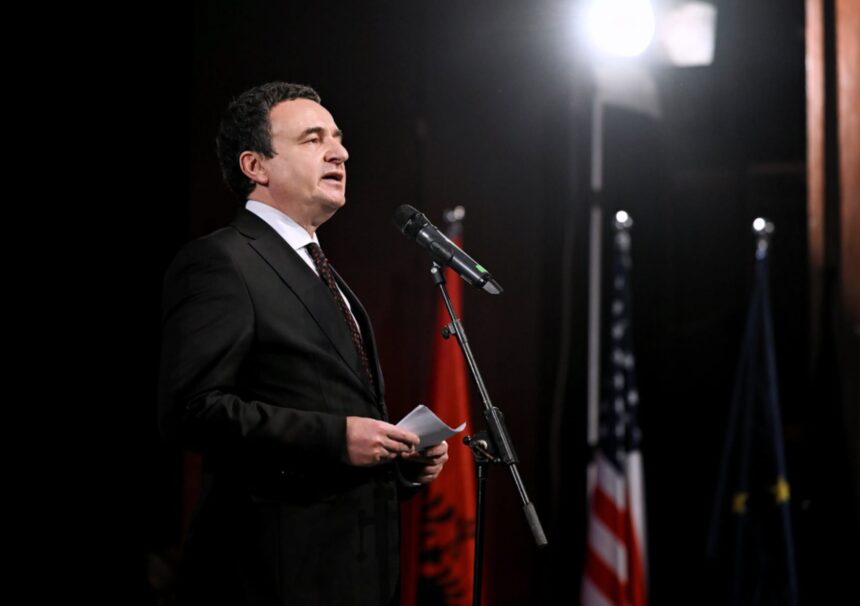
Kosovo Prime Minister Albin Kurti has called on Albanians to find common ground despite their differences, drawing on the legacy of the Congress of Manastir as an example of what can be achieved through unity and compromise.
Kurti delivered the remarks in Manastir, now known as Bitola, during a ceremony marking the 118th anniversary of the Congress of the Albanian Alphabet, held on 22 November 1908.
In his speech, Kurti reflected on the historic decision to establish a common alphabet for the Albanian language, emphasising that the delegates came from different religious, regional and ideological backgrounds but managed to reach an agreement.
He recalled that around 50 delegates attended the Congress, including Parashqevi Qiriazi, its only female participant. They represented different communities and traditions, and brought with them their own convictions and preferred writing systems.
Kurti noted that the delegates did not initially agree on a single alphabet. The commission chaired by Gjergj Fishta ultimately proposed the adoption of two alphabets: the Istanbul alphabet and a purely Latin-based one. Although the Congress itself described this as a step backwards, Kurti said it was a compromise that prevented the gathering from failing in its mission.
Ten years later, the Latin alphabet, based on the version promoted by the Bashkimi Club of Shkodra, became the common alphabet of Albanians.
Kurti also stressed that the Congress was not exclusively a linguistic event. According to historians, it also articulated political demands for the recognition of the Albanian nationality and language. Four years later, Albania declared its independence in Vlora.
“Although 118 years have passed, the question of the Congress of Manastir remains the same: How do we reach agreement when we do not think alike?” Kurti said.
He pointed out that Albanians today live in several countries and across a far-reaching diaspora, while being divided by political parties, regions, generations and interests. Such differences, he said, are natural in a free society. The real danger lies in viewing agreement as weakness and compromise as a form of betrayal.
“The patriots of 1908 left us a simple lesson: an agreement does not require all differences to disappear. It requires us to put something greater than each of us individually above those differences,” Kurti said, identifying the Albanian language as the foundation of national identity.
Addressing contemporary challenges, Kurti also highlighted the impact of rapid technological development, including robotics and artificial intelligence, on the Albanian language.
He called on academies, universities, education ministries and language institutes to develop appropriate Albanian translations and terminology for emerging concepts and technologies, warning that otherwise foreign words would increasingly find their way into public discourse at the expense of Albanian.
Kurti said the best way to preserve and protect the language was to expand and develop it with new words and expressions suited to the demands of the 21st century.
“Our future is written in the beautiful Albanian language,” he concluded.