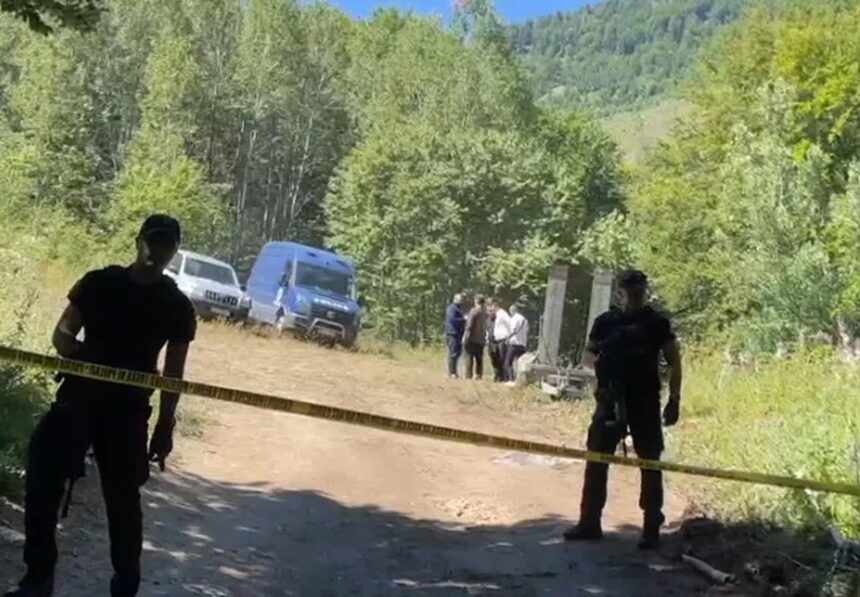
DNA analysis has confirmed the identities of three victims of the Kosovo War whose remains were exhumed at sites in Kalludër and Jabukë, in the municipality of Zubin Potok.
Prime Minister Albin Kurti said that, at the start of his visit to the United States, he was informed by the Government Commission on Missing Persons that the International Commission on Missing Persons (ICMP) had delivered the first three DNA reports based on samples taken from human remains exhumed at the mass grave sites in Kalludër and Jabukë.
“In less than two months since the first mass grave was confirmed, DNA analysis has identified three victims, establishing their connection to the group known as the ‘Group of Intellectuals’—primarily citizens from Skenderaj and Mitrovica, who were abducted and forcibly disappeared on April 19, 1999, by Serbian forces,” Kurti wrote on Facebook.
According to Kurti, the DNA reports were shared with the Institute of Forensic Medicine, and representatives of the Government Commission on Missing Persons and the Institute immediately informed the families of the three identified victims.
“In the coming days and weeks, we expect to receive additional reports for the samples submitted for identification through DNA analysis, with the hope that other families will also receive the answers they have been waiting for for 27 years. No answer can erase the pain of loss, but knowing the truth brings an end to the anguish of waiting to learn the fate of our loved ones,” he wrote.
Kurti also recalled that on July 27, the discovery of a mass grave in Kalludër was confirmed.
“During my visit to this location, I emphasized that it is vital for international actors, led by the United States, the United Kingdom and the European Union, to increase pressure on Serbia to implement the Declaration on Missing Persons, agreed on May 2, 2023, in Brussels. In particular, this includes the immediate opening of archives, including those of the 37th Motorized Brigade of the Yugoslav Army, which carried out massacres in Kosovo, particularly in Drenica, and whose documentation Serbia classified in 2014 for a period of 30 years,” Kurti wrote.
He also stated: “Our institutional commitment will continue through field searches, support for the identification process, and direct and careful communication with families. We will stand by them and support their demands for truth, justice and the dignified return of their loved ones.”
According to Kurti, uncovering the fate of every person who was forcibly disappeared is a state priority for the Republic of Kosovo and a human obligation that remains unresolved as long as even one family continues to wait for an answer.
“During my visit to the United States and at meetings held as part of the 81st session of the UN General Assembly, as every day in my work and that of the Government of the Republic of Kosovo, the truth about the fate of our loved ones and justice for the victims and their families will remain at the center of our efforts. An integral part of this agenda will be the request for the United States, the European Union and the United Kingdom to increase pressure on Serbia to implement its commitments, open the archives and provide information that can help establish the fate of persons who were forcibly disappeared,” Kurti wrote.