The Middle East has edged closer to full-scale regional warfare following a coordinated, multi-theater strike launched by Iran’s Islamic Revolutionary Guard Corps (IRGC) against United States military installations in Bahrain, Kuwait, and Jordan.
The dynamic military escalation is direct retaliation for recent aggressive US conventional strikes targeting sovereign Iranian ports and militarized islands within the highly volatile Strait of Hormuz.
The Theater of Warfare: Targets and Interceptions
According to official declarations broadcasted via Iranian state media, the IRGC simultaneously activated drone corridors and long-range ballistic missile systems to target major logistical hubs housing American service members:
Iranian Retaliatory Strike Vectors (June 11, 2026)
                        [ IRGC Command (Iran) ]
                                  │
         ┌────────────────────────┼────────────────────────┐
         ▼ (UAV Drone Swarms)     ▼ (UAV Drone Swarms)     ▼ (Long-Range Missiles)
[ US 5th Fleet Base ]    [ Ali Al Salem Air Base ]   [ Muwaffaq Salti Air Base ]
     (Bahrain)                (Kuwait)                  (Azraq, Jordan)
         │                        │                        │
         └────────────────────────┼────────────────────────┘
                                  ▼
                [ ALL PROJECTILES INTERCEPTED ]
                    • Zero Casualties Reported
                    • Integrated Air Defenses Fully Active
- The Marine Vector: Swarms of one-way attack drones targeted the heavily fortified US Navy Fifth Fleet Headquarters in Bahrain.
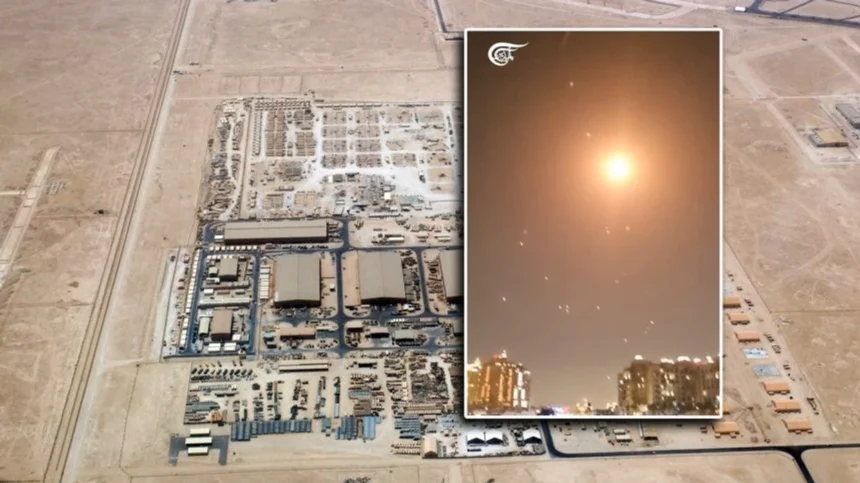
- The Kuwaiti Vector: Autonomous aerial drones targeted the Ali Al Salem Air Base in Kuwait, a central hub for US regional air operations.
- The Levantine Vector: Long-range ballistic missiles traversed regional airspace to hit a vital US-utilized military installment in Azraq, Jordan (Muwaffaq Salti Air Base).
Military field reports confirm that joint allied integrated air defense networks successfully tracked and neutralized all incoming projectiles. No casualties or catastrophic infrastructure damages have been reported.
The Catalyst: The Apache Helicopter Incursion
The rapid breakdown in security follows a violent chain reaction of military actions in the Persian Gulf earlier this week:
- Tuesday, June 9, 2026: A US military Apache helicopter was shot down over the Persian Gulf. Washington immediately blamed Iranian anti-air batteries for the downing.
- Wednesday, June 10, 2026: In a rapid retaliatory response, the US military launched heavy conventional bombardments against Qeshm Island and multiple strategic ports along the Iranian coastline in the Strait of Hormuz.
- Thursday, June 11, 2026: The IRGC responded with the multi-nation drone and missile strikes, warning that they remain fully combat-ready for a “decisive” war and that Washington carries complete accountability for the breakdown of regional stability.
Trump Declares Peace Talks Frozen, Vows Retaliation
The military flare-up has effectively derailed highly sensitive, behind-the-scenes diplomatic negotiations aimed at de-escalating the broader conflict. Just twenty-four hours prior, US President Donald Trump had optimistically announced that Washington and Tehran were “two or three days away” from finalizing a sweeping comprehensive treaty.
Following the IRGC’s regional bombardment, President Trump shifted his tone entirely, accusing Tehran of intentionally stall-tacticking peace talks to reorganize its military positions.
| State Actor | Current Geopolitical Stance | Imminent Strategic Warning |
| United States (President Trump) | Accuses Tehran of intentionally dragging out diplomatic negotiations that “would have been great for them.” | “Now they will have to pay the price,” indicating that heavy kinetic or economic retaliation is imminent. |
| Iran (IRGC Command) | Views the strikes as a defensive, sovereign right following unprovoked US operations against Iranian coastal infrastructure. | Warns that any subsequent American counter-strikes will be met with a vastly superior, multi-axis response across the globe. |
With regional air defense systems remaining on the highest level of combat readiness, international energy markets are bracing for massive volatility as the threat of a prolonged blockage of the Strait of Hormuz looms large.