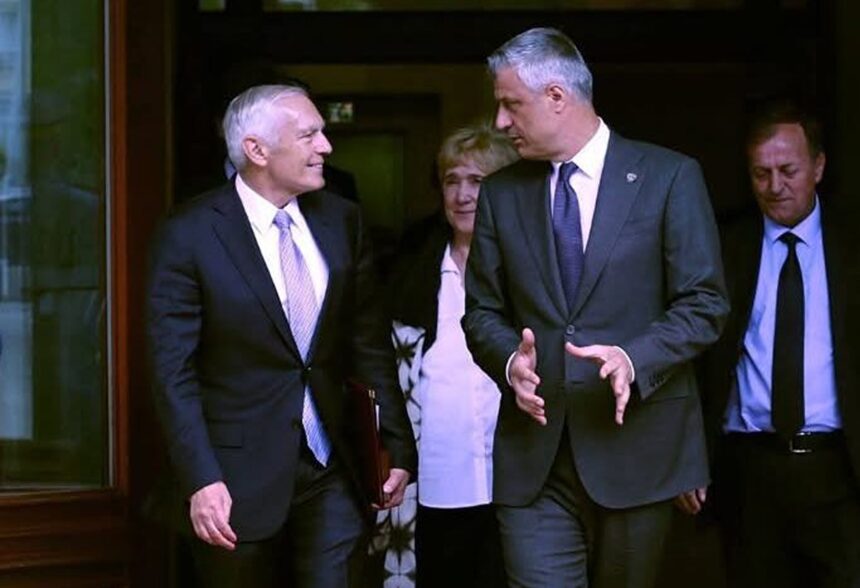
Former NATO General Wesley Clark has criticized the Kosovo Specialist Chambers over the convictions of former leaders of the Kosovo Liberation Army (KLA).
Clark described Slobodan Milošević as having a “genocidal mindset” and praised Hashim Thaçi, saying the former Kosovo president was a patriot who returned to his homeland to defend it during a time of crisis.
“During the war, we asked Milošević to withdraw his forces and gave him a document confirming this. He told me that Albanians were killers and rapists. He said, ‘We have dealt with the Albanians before, we have the solution, and we will kill them all.’ Milošević signed the document, but in January he sent his forces back into Kosovo and resumed the ethnic cleansing. Milošević can never be compared with Hashim Thaçi. Thaçi was a patriot who returned to his own country in a time of crisis,” Clark said in an interview with Klan News.
The former NATO general also described Milošević as stubborn and determined to defeat the KLA and the people of Kosovo.
“He was convinced that he would put an end to the KLA and the people of Kosovo. Serbia had arrested and killed intellectuals and told people, ‘Give us your property and your young women, otherwise we will kill you.’ Milošević knew what was happening on the ground. When we saw that the situation had become serious, we intervened and bombed Serbia,” Clark said.
Asked whether NATO’s intervention in Kosovo was intended to divert attention from the scandal involving former U.S. President Bill Clinton, Clark rejected the claim outright.
“That is a ridiculous statement—that the intervention in Kosovo was carried out to divert attention from the Bill Clinton scandal,” he said. Clark referred to the genocide in Rwanda and the ethnic cleansing in Bosnia and Herzegovina, saying the United States and NATO could not allow similar atrocities to be repeated in Kosovo.
He recalled the 1995 war in Bosnia and Herzegovina, saying NATO’s intervention there ultimately helped bring Milošević to the negotiating table. He also referred to the Dayton agreement, which established a 51–49 territorial division between the Federation of Bosnia and Herzegovina and Republika Srpska.
Clark said the situation in Kosovo became increasingly serious in 1998, referring to the killing of members of the Jashari family and the escalation of the conflict. He said Milošević was determined to eliminate the rights of Kosovo’s Albanians, while adding that his precise intentions regarding the future demographic and political composition of Kosovo were difficult to determine.
“The hatred between Albanians and Serbs continues to some extent. We did what we could. Let us begin building a better relationship in the region,” Clark concluded.