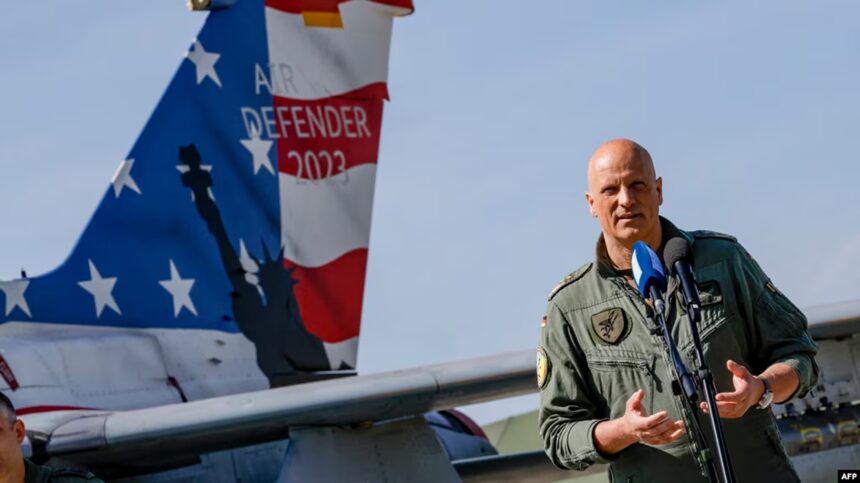
Germany must urgently strengthen its capabilities to counter both conventional and hybrid attacks, NATO General Ingo Gerhartz said amid growing concerns over Russian aggression and other low-level threats across Europe.
At the opening of a two-day conference in Berlin on November 18, focused on reinforcing European defense, Gerhartz stated, “Our main challenge is deterrence, and deterrence today must address all forms of coercion.”
He emphasized that, to respond effectively to an increasing number of hybrid attacks, Germany needs rapid reforms in military procurement, swift implementation of the new military service law, and strengthened defense readiness across society.
“To transform investments into deterrence, institutions must change, processes must adapt, and most importantly, our entire society must be engaged,” he said.
Gerhartz expressed concern over the months-long debate on whether and how to implement military service in Germany, which was only politically resolved last week. He added that Russia also recognizes that the German procurement process sometimes takes years, and that industry struggles to increase weapons production.
“This shows that Germany, as a whole, has not yet achieved the strategic maturity required for this era,” argued Gerhartz, who commands NATO’s operational headquarters in Brunsum, the Netherlands, known as the Allied Joint Forces Command.
He also stressed the need to discuss how deterrence can function in the so-called “grey zone” of hybrid attacks, which may not trigger NATO’s Article 5 obligations. “We need to rethink our approach to deterrence,” Gerhartz said.
Politicians, military officials, and defense experts gathered in the German capital for the conference, which will feature more than 140 speakers in keynotes and panel discussions.
Participants aim to examine ways to respond to a range of threats facing NATO and the European Union, including measures to increase arms production and adopt new technologies.
German Defense Minister Boris Pistorius and Swedish Defense Minister Pal Jonson also attended the conference.
In his remarks, Pistorius called on Germany’s European allies to rapidly expand defensive readiness across the continent. He also referenced the growing threat from Russia. Pistorius signed an agreement with Jonson to enhance military cooperation with Sweden, a NATO member state.
He highlighted that Moscow is already conducting large-scale hybrid attacks, using cyberattacks, espionage, sabotage, and disinformation campaigns.
Pistorius noted that the Baltic Sea, traditionally seen as a connection between European countries, is increasingly becoming a zone of tension, serving as a testing ground for Russian President Vladimir Putin to assess Europe’s capacity to deter and respond. He also mentioned damaged underwater cables, airspace violations, and drone flights.