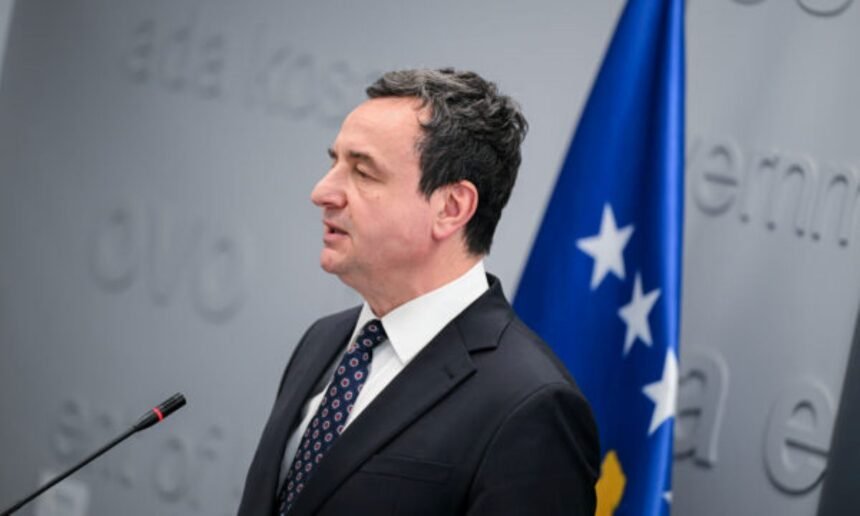
Kosovo’s Prime Minister, Albin Kurti, has defended the government’s strategic pivot toward creating a national Gendarmerie and adopting a “comprehensive defense” model, asserting it is a far more effective security framework for the country than introducing mandatory military service.
Responding to questions from T7 journalist Genc Godanci regarding whether the Gendarmerie initiative would face the same stagnation as his 2019 campaign promise for compulsory military service, Kurti detailed a fundamental shift in Kosovo’s national security doctrine.
The Road to the Gendarmerie Law
Kurti confirmed that the initial concept document for the new paramilitary force is nearing completion. Once finalized, the executive branch will immediately draft the formal Law on the Gendarmerie and fast-track it to the Assembly of Kosovo for legislative approval.
Unlike the broader logistical hurdle of mandatory service, Kurti emphasized that the Gendarmerie has a clear, actionable path toward institutional reality.
Pivoting to the “Finnish Model” of Comprehensive Defense
Addressing the sidelined promise of mandatory conscription, Kurti explained that thorough consultations with defense experts revealed that building a mass-conscript military is overly complex, financially straining, and structurally inefficient for Kosovo’s current geopolitical landscape.
Instead, the government is officially modeling its national defense strategy after Finland’s Comprehensive Defense doctrine.
“We have assessed with experts that in our current situation, it is much wiser to adopt a comprehensive defense model, similar to that of Finland,” Kurti stated. “Instead of creating a massive army of conscripts that we must continuously structure and equip, we define concrete functions and specific duties for various risk scenarios—ranging from natural disasters to armed conflict.”
[Kosovo's Comprehensive Defense Framework]
├── Finnish Model   --> Decentralized, function-specific tasks for crisis & wartime scenarios.
├── Polish Model    --> Security and defense education integrated into secondary schools.
└── Domestic Pillar --> Creation of an active Voluntary Reserve for the Kosovo Security Force (KSF).
Three Pillars Over Conscription
According to the Prime Minister, this decentralized, hyper-flexible security framework is structurally superior to standard mandatory service because it relies on a highly prepared, multi-layered society rather than a rotating pool of raw recruits. The strategy is built upon three pillars:
- The Comprehensive Function Model (Inspired by Finland): Training civilian sectors, public enterprises, and institutions to immediately pivot and execute specialized defense roles during a state of emergency or conventional war.
- Security Education in High Schools (Inspired by Poland): Integrating mandatory security, resilience, and basic defense concepts into secondary education curricula to foster early civic preparedness.
- The KSF Voluntary Reserve: Establishing a robust, well-regulated, and highly motivated voluntary reserve force within the Kosovo Security Force (KSF) to bolster active-duty ranks during a crisis.
“This approach is vastly superior to mandatory military service,” Kurti concluded, signaling a permanent doctrine evolution toward specialized, agile, and total-society defense mechanisms.