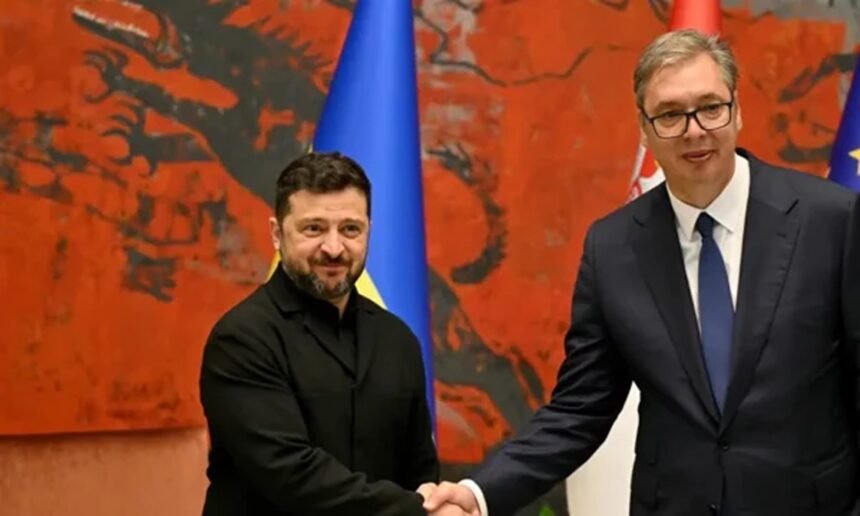
The visit of Ukrainian President Volodymyr Zelensky to Serbia last week and his first meeting with President Aleksandar Vučić triggered strong reactions in both Pristina and Belgrade, while Kyiv’s position on Kosovo’s independence once again brought one of the Balkans’ most sensitive political issues into the spotlight.
Following the meeting in Belgrade, Zelensky stated that Ukraine would not recognize Kosovo’s independence. The statement immediately sparked reactions in Kosovo.
In Pristina, a “Free Ukraine” banner that had been displayed on one of the capital’s main streets since 2022 was removed. Pristina Mayor Përparim Rama said that solidarity with peoples facing war and persecution should be accompanied by mutual respect.
Tensions also escalated in Belgrade and Pristina. Vučić stated that Serbia could divert the course of the Ibër River, a threat linked to developments concerning Serbian properties in Kosovo. Such a move would have serious consequences, as the reservoir supplies water to a large part of Kosovo and is also used to cool the country’s main power plant.
Meanwhile, a public confrontation unfolded on X between Serbian Foreign Minister Marko Đurić and Albanian Prime Minister Edi Rama. Rama accused Belgrade of living in a “political bubble” and refusing to accept the reality of having lost Kosovo.
Why did Zelensky move closer to Vučić?
Behind Zelensky’s statements on Kosovo, however, lies another dimension of his visit — Ukraine’s military needs.
Serbia continues to produce significant quantities of ammunition using calibers inherited from Soviet standards. Such ammunition remains important to the Ukrainian military, which still relies considerably on weapons manufactured according to Soviet standards.
According to the analysis cited in the report, the Serbian president may be willing to discreetly assist Ukraine with such supplies, despite Belgrade’s continued close relations with Moscow.
“Ukraine is in a situation where it cannot deal with anything other than its most urgent needs, while Vučić is currently more important to it,” said Florian Bieber, head of the Centre for Southeast European Studies at the University of Graz.
This makes Serbia a potentially important partner for Kyiv in an area where Ukraine’s needs remain substantial.
Vučić seeks to improve his position with the EU
The rapprochement between the Ukrainian and Serbian presidents may also have another dimension — Vučić’s relationship with the European Union.
Serbia remains under constant pressure from Brussels over its domestic policies, relations with Russia and concerns regarding democratic standards.
In this context, images of Vučić alongside Zelensky and the public rapprochement with the Ukrainian president could help Belgrade present a more Western-oriented profile.
According to Bieber, Vučić may hope that closer, at least symbolic, relations with Zelensky will bring fewer criticisms from Brussels in the coming months and strengthen his position vis-à-vis the EU, particularly ahead of possible elections in Serbia.
Kosovo remains the most sensitive issue
Despite the shared interests that Belgrade and Kyiv may have, the issue of Kosovo remains one of the main obstacles in relations between Ukraine and Kosovo.
Ukraine does not recognize Kosovo’s independence, while in Pristina Kyiv’s position has been met with disappointment, particularly given the strong support Kosovo has provided to Ukraine since the beginning of Russia’s invasion.
Kosovo’s Foreign Minister Glauk Konjufca said he regretted Zelensky’s position and compared it with arguments used by Russia to portray Kosovo as a precedent for other territorial conflicts.
The status of Kosovo has for years been used by Russian President Vladimir Putin in his narrative concerning Russian interventions and annexations, including in Georgia and Crimea.
However, supporters of Kosovo’s independence argue that its case is unique and cannot be used as a general precedent for separatist movements or territorial conflicts.
A pragmatic relationship above the Balkans’ disputes
Zelensky’s visit to Belgrade therefore reflects a reality more complex than the direct dispute over Kosovo.
For Kyiv, Serbia may be important because of its ammunition-production capabilities. For Vučić, closer relations with Zelensky could help improve Serbia’s image in the eyes of the EU and demonstrate that Belgrade can play a mediating role between different sides.
But this rapprochement does not erase the political dispute over Kosovo, nor Serbia’s traditional ties with Russia.
Ultimately, as Bieber points out, how Kosovo’s independence is interpreted depends heavily on one’s position in this dispute and on one’s broader view of conflicts and territorial disputes elsewhere in the world.