Saudi Arabia, Turkey and Pakistan have signed a new mutual defense agreement under which an armed attack against any one of the three countries will be considered an attack against all three.
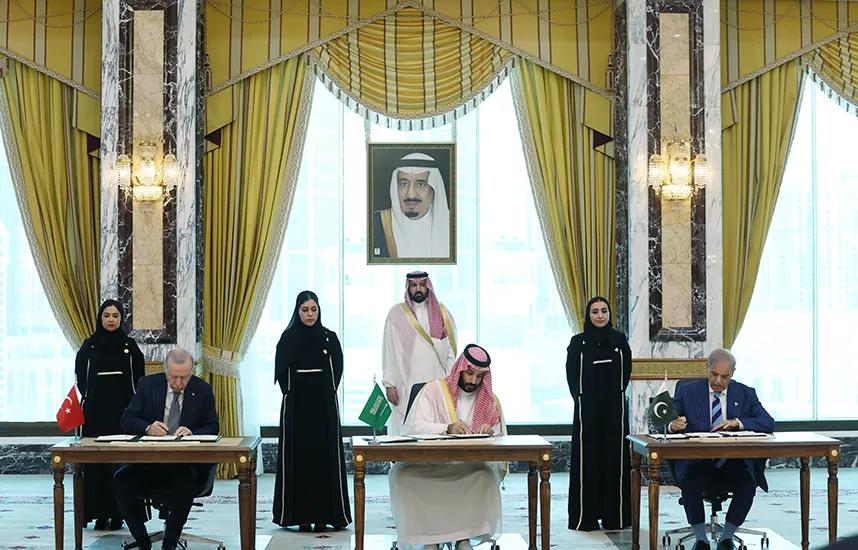
The agreement, described as the “Makkah Joint Defense Agreement,” was signed Friday in the Saudi holy city of Mecca during a meeting between Saudi Crown Prince Mohammed bin Salman, Turkish President Recep Tayyip Erdoğan and Pakistani Prime Minister Shehbaz Sharif.
The pact brings together three Sunni-majority Muslim countries with significant strategic capabilities: oil-rich Saudi Arabia, nuclear-armed Pakistan and Turkey, which has NATO’s second-largest military and a growing defense industry.
“The agreement aims to strengthen collective deterrence against any act of aggression and establishes that any armed attack against any of the three countries will be considered an attack against all,” Pakistan’s Foreign Ministry and Turkey’s Presidential Communications Directorate said in matching statements, according to The Associated Press.
The agreement comes amid heightened regional tensions and uncertainty, including the ongoing war involving Iran. Critical infrastructure and Saudi oil facilities have been targeted during the conflict, prompting Riyadh to seek greater diversification of its defense partnerships.
Saudi Arabia and Pakistan had already signed a bilateral mutual defense pact in September, which similarly stated that an attack against either country would be considered an attack against both.
The new trilateral agreement also comes amid growing tensions between Turkey and Israel over Gaza and wider regional conflicts involving Iran and Lebanon.
A Turkish government official described the new pact as “entirely defensive,” emphasizing that the three countries had committed to mutual support solely for defensive purposes.
According to the official, the agreement is not directed against any specific country or actor and could remain open to additional regional countries joining in the future.
While the agreement does not establish a NATO-style alliance, its collective-defense clause marks a significant step toward closer military coordination among three influential Muslim-majority states.