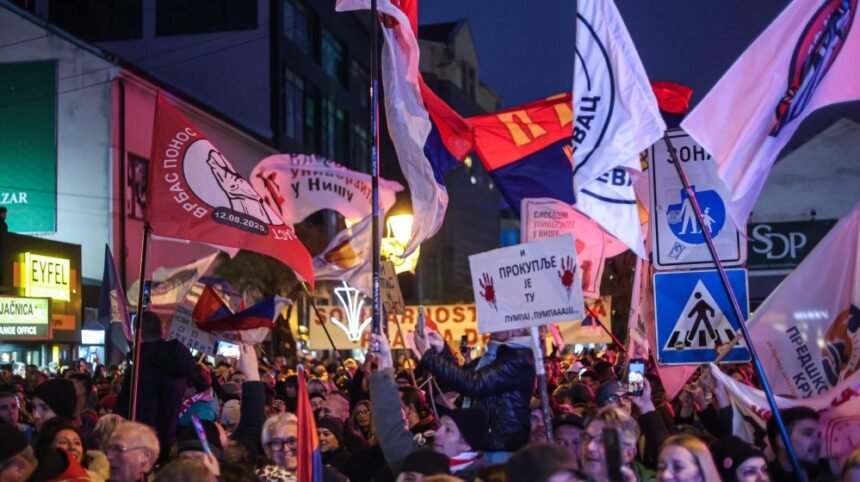
Students involved in the ongoing civic blockade in Novi Sad have announced a major protest for January 17, signaling that their campaign for political change is far from over.
The students, primarily from the Faculty of Natural Sciences and Mathematics, wrote on their “X” profile:
“We declared victory on December 28, and soon we will show you what that victory means. January 17, Novi Sad.”
The announcement follows a nationwide signature collection campaign on December 28, aimed at pushing for snap parliamentary elections. Students claim they collected over 393,000 signatures across Serbia, including 40,000 in Novi Sad and 93,000 in Vojvodina, through the initiative “Raspiši pobedu” (“Call the Victory”). They described the campaign as a demonstration of civic engagement, emphasizing that individual participation and unity can bring meaningful political change.
Vučić Questions Students’ Claims
President Aleksandar Vučić publicly challenged the students’ numbers, claiming they had not collected “even seven percent” of the signatures they asserted. He cited official monitoring of 346 collection points and alleged that some forms were destroyed by his supporters.
Despite the students’ efforts, Vučić dismissed the campaign as “normal political activity”, equating it to traditional party-organized signature drives. He also warned that the true measure of the students’ mobilization would only be seen during formal elections, implying skepticism about their capacity to effect change.
Critics argue that Vučić’s dismissal undermines legitimate civic activism, and reflects a broader trend of political leaders seeking to discredit grassroots movements while maintaining control over electoral narratives. The students, however, emphasize that their campaign is not just about numbers but about building the largest network of civic engagement in modern Serbian history.
Significance and Next Steps
The January 17 protest is being positioned as a key step in sustaining momentum from the December signature campaign. The students’ goal is not only to pressure the government but also to demonstrate the potential power of organized civic action.
Vučić also highlighted the upcoming elections as “the most important in modern Serbian history”, stressing meticulous vote counting. Yet, observers note that his comments may serve more to preemptively delegitimize opposition mobilization than to ensure transparency.
The tension between student activism and state authority continues to shape Serbia’s political landscape, with the January protest set to test both civic engagement and the government’s responsiveness.