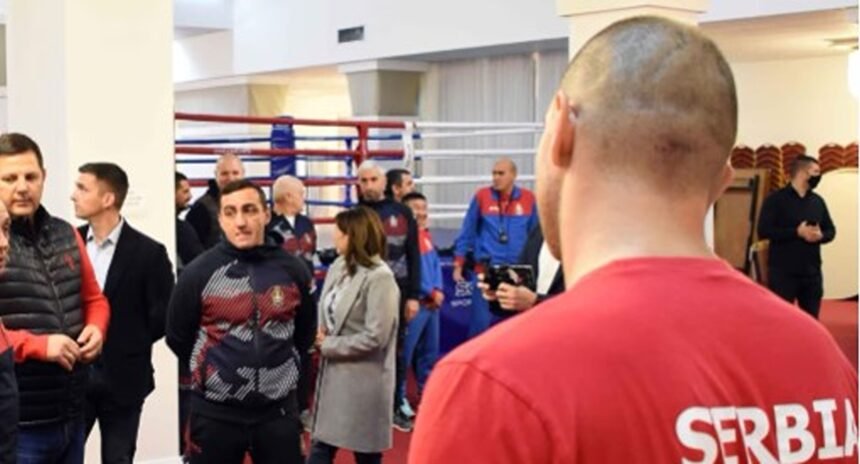
The Boxing Federation of Serbia has been renamed the Serbian Boxing Federation.
The Olympic Committee of Serbia is also moving toward a similar change.
This follows decisions by the Water Polo Federation and Handball Federation, which previously adopted names that, according to their statements, “clearly define their affiliation with the nation they represent.”
The Boxing Federation explained the name change by saying that it more clearly “expresses the identity, tradition, and affiliation with Serbian boxing.”
As federations one after another remove “Serbia” from their names and add the word “Serbian,” some clubs from areas inhabited by national minorities have expressed concern.
Officials from Novi Pazar Boxing Club told RFE/RL that they considered the name “Boxing Federation of Serbia” more appropriate because it included all people within the territory of Serbia equally.
“From a grammatical perspective, this refers to members of a nation. As members of a minority nation, we believe that this has isolated us from the new name,” they said.
Club officials said they were certain this was not the intention, but that “this is how it comes across linguistically.”
Nevertheless, they added that the name change would not alter Novi Pazar Boxing Club’s position that they are equal participants in the federation and would continue cooperating as before.
On August 11, the Boxing Federation of Serbia announced that the change had been made in accordance with “the name of our country and our people.”
It added that the change came primarily in response to an initiative by a large number of boxers, coaches, and boxing clubs from Serbia and the Bosnian entity of Republika Srpska.
According to the federation, the initiative expressed a desire for the federation’s name to “more clearly reflect the identity, tradition, and affiliation with Serbian boxing.”
“At the national team level, the differences regarding the faith and religion of all its members will be fully respected,” said Nenad Borovčanin, president of the National Boxing Federation at the time.
The Serbian Boxing Federation did not respond to RFE/RL’s questions.
National federations bring together sports clubs, associations, organizations, and regional federations within a particular sporting discipline.
What Does “Serbian Federation” Mean Instead of “Federation of Serbia”?
“In our context, the adjective ‘Serbian’ is primarily associated with Serbdom, with those who are ethnically Serb,” cultural studies scholar Milena Dragićević Šešić told RFE/RL.
The Water Polo Federation of Serbia, which started the domino effect among sports federations, referred to examples of other water polo and swimming federations around the world.
Among those cited were the Hungarian Water Polo Federation, Russian Water Polo Federation, Italian Swimming Federation, and Croatian Water Polo Federation.
“Now the Serbian Water Polo Federation has also adopted a name that clearly defines its affiliation with the nation it represents,” the federation said in a July 1 announcement.
It added that the national water polo organization had thereby adopted a name that more clearly emphasized its affiliation with Serbian sport.
An identical announcement came from the Handball Federation of Serbia, which on August 9 changed its name to the Serbian Handball Federation.
“Someone might ask how it can be French, for example, but among the French it is clear that the adjective ‘French’ does not refer to ethnicity but to the French state,” Dragićević Šešić explained.
Serbia’s Olympic Committee Also Changes Its Name
The wave of name changes has also reached the Olympic Committee of Serbia, which on August 11 initiated proceedings to change its name to the Serbian Olympic Committee.
A proposal was also launched for the Olympic Committee of Serbia to send an initiative to the Ministry of Sport, national sports federations, the Sports Federation of Serbia, and the Serbian Paralympic Committee, asking them to consider and support the proposed name change.
The possibility of creating a unified conceptual and graphic design for the emblems of national sports federations was also raised, with the aim of “achieving greater visual recognition and unity within Serbian sport.”
The Olympic Committee of Serbia was founded in 1910 as the Serbian Olympic Club. According to its official website, its seal already bore the name Olympic Committee of Serbia in 1912.
Over the years, as Serbia’s state arrangements changed, the Olympic Committee also changed its name, returning in 2006 to the name Olympic Committee of Serbia.
Before the current wave of renaming sports federations as Serbian federations, the Athletic Federation of Serbia changed its name in 2020 to the Serbian Athletics Federation, returning to the name it had originally used at the beginning of the 20th century.
Six years ago, however, the change was explained as an effort to make communication with foreign federations easier and improve recognition in search engines.
Why Was the Change Necessary?
Cultural studies scholar Milena Dragićević Šešić considers the changes to be connected to the current policies of the Serbian state.
Or, as she puts it, to President Aleksandar Vučić, who wants to do everything that “can be characterized relatively cheaply as a patriotic initiative.”
“Encouraging changes to the names of various sports federations is evidence of loyalty to the regime,” Dragićević Šešić said.
The sports federations that changed their names did not respond to RFE/RL’s questions about why the changes were made and whether they had considered athletes belonging to other nationalities in Serbia when making the decisions.
The only federation to respond was the Serbian Water Polo Federation, which said that all information regarding the name change could be found in its announcement following the July 1 assembly.
That announcement stated that the name was changed on the basis of a new statute adopted at the July 1 assembly.
The Water Polo and Handball federations said the new statutes were also adopted to bring them into compliance with the Sports Law and to regulate the federations’ operations more clearly.
Under Serbia’s Sports Law, a national sports federation in a particular discipline uses the name of the Republic of Serbia in its official name, in accordance with the law.
Serbia’s Ministry of Sport did not respond to RFE/RL’s questions regarding the name changes of several national sports federations.
Commenting on sports policy, Dragićević Šešić said that instead of investing in the development of sport, the state invests in stadiums and projects that are highly visible from a marketing perspective.
She sees the addition of the designation “Serbian” to sports federations as an attempt by the authorities to reinforce the idea “that only this government is the protector of Serbdom and the Serbian name.”
Anthropologist Svetlana Slapšak told RFE/RL that “the sense of being a citizen disappeared a long time ago under the regime that currently governs Serbia.”
“When someone needs to do something like this in sport, it simply represents the culmination of nationalism and populism,” she said.
Both scholars recalled that a similar situation existed in the late 1980s.
“There were also people in Serbia who were dissatisfied with the name Serbian Writers’ Association in socialist Yugoslavia, because in Croatia it was the Croatian Writers’ Association and in Slovenia it was the Slovenian Writers’ Association,” Dragićević Šešić said.