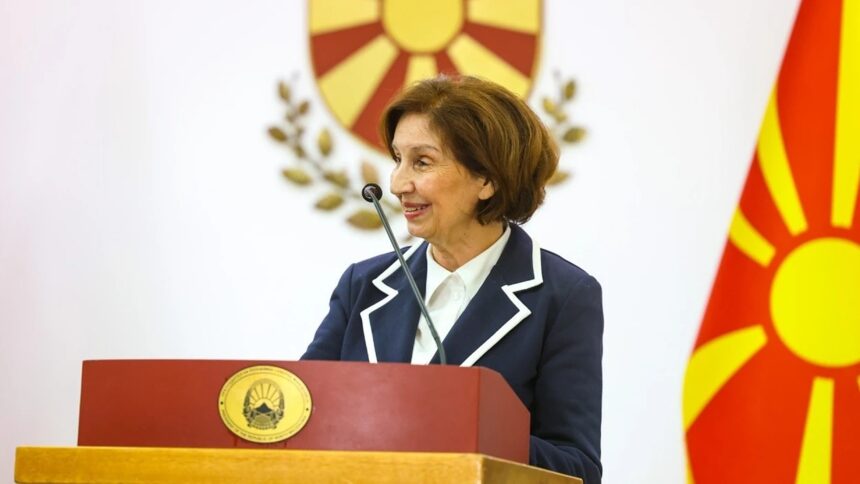
President Gordana Siljanovska-Davkova says the issue surrounding North Macedonia’s European integration and the conditions linked to Bulgaria cannot be characterized exclusively as a bilateral matter or simply as a problem between the country and the European Union.
In an interview with Sitel, Siljanovska-Davkova focused on her recent meeting with European Commission President Ursula von der Leyen and the possibility of the EU mediating talks with Bulgaria.
Regarding messages from Brussels about continuing talks with Sofia, she recalled that the question had previously been raised as to whether the dispute was bilateral or an issue within the framework of relations with the EU.
“When we said that the issue was bilateral in nature, because neither in the Action Plan nor previously had there been objections from other countries, and nobody was threatening with a veto—instead, the need for a merit-based evaluation system was emphasized—Bulgaria said that the issue was not bilateral, but that it concerned the European Union. I have said many times that if that is the case, then let us negotiate with the European Union,” Siljanovska-Davkova said.
According to her, in such situations there are mechanisms under European law, including Article 7 of the Treaty on European Union, which provides for the possibility of restricting certain rights of a member state if a serious breach of EU principles and values is established.
Nevertheless, the president stressed that dialogue and an exchange of views are necessary, but that the issue or process cannot be characterized as exclusively bilateral or simply as a problem between North Macedonia and the European Union.
Regarding statements by European representatives about commitments that have been undertaken, Siljanovska-Davkova referred to European constitutional law and the EU’s fundamental documents.
“I am not only the president, but also a professor. I know European constitutional law well. And what Ms. Yotova, the President of Bulgaria, has been referring to these days when she says that we must respect the principles and values of the European Union are precisely the issues I am talking about. It is clearly written in the Treaty on European Union, the Lisbon Treaty and the Charter of Fundamental Rights that the EU will respect national and cultural identity, not only of EU members, but of all nations and states,” Siljanovska-Davkova said.
She added that European documents also provide for respect for the constitutional and political structures of states.
Siljanovska-Davkova said these principles should be taken into account in the country’s European integration process, particularly when it comes to issues related to national and cultural identity.
Regarding the demand for constitutional amendments, the president said she could not guarantee that they would be adopted.
“What do I say when I am asked whether we will change the Constitution? I cannot give such a guarantee. MPs do not represent me; they represent the citizens and, as in every European parliament, they vote according to their convictions,” Siljanovska-Davkova said.
She questioned what would happen if constitutional amendments were initiated again but MPs failed to secure the required two-thirds majority, as well as the necessary majority of MPs from non-majority communities.