Kosovo entered and concluded 2025 amid intense electoral activity, with citizens heading to the polls four times in one year. Two parliamentary elections and two rounds of local elections were held. Following the snap parliamentary elections on December 28, the main expectation is that both the winning and opposition parties will avoid triggering another election in spring 2026 during the presidential selection process.
Election Timeline and Results
Kosovo held parliamentary elections in February, local elections in October, a second round of local elections in November, and snap parliamentary elections in December.
The first parliamentary election did not yield a functional government. Political parties clashed over mandates, preventing the formation of institutions. By December 28, some parties lost votes while one gained, reflecting the shifting political landscape.
In the December elections, from over 900,000 regular votes, Lëvizja Vetëvendosje (LVV) emerged as the leading party with 49.33% (432,000 votes). With the diaspora and conditional votes still pending, LVV had secured 36,000 more votes than in February.
The Democratic Party of Kosovo (PDK) came second with 21% (184,000 votes), losing over 12,000 votes compared to February. Democratic League of Kosovo (LDK) suffered the largest loss, dropping from 18.27% to 13.57%—a decrease of about 52,000 votes. Alliance for the Future of Kosovo (AAK) also lost votes, falling from 7.06% to 5.66%. Meanwhile, the Serb List gained slightly, receiving 42,235 votes, over 2,000 more than the previous election.
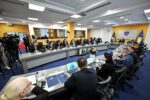
Based on preliminary counts, LVV secured 56 parliamentary seats, PDK 23, LDK 15, and AAK 6, enabling LVV to form a parliamentary majority with votes from non-Serb minority deputies and thus form the government.
Polarizing Campaign and Political Tensions
The February election campaign was highly polarizing, with LVV criticized by the EU Election Observation Mission for rhetoric perceived as divisive. During this period, LVV called for nearly 500,000 votes, receiving 396,000. The opposition focused on limiting LVV’s dominance rather than increasing their own electoral base.
Parliamentary Deadlock
Despite LVV’s success, forming the parliament was a challenge. Between April and October, consecutive sessions failed to constitute the assembly, blocked primarily by disputes over leadership posts. The PDK eventually facilitated progress by voting for LVV’s fifth proposed candidate for Assembly Speaker. Other parties, particularly LDK, resisted all alternatives and conditions set by both LVV and other opposition parties.
Ultimately, the Assembly was constituted on October 10, but votes to approve the government failed twice. On November 20, the President dissolved the Assembly and called snap parliamentary elections for December 28.
Local Elections and Power Distribution
Two rounds of municipal elections in the midst of parliamentary contests produced balanced local governance. LVV won seven municipalities—its largest local success to date—while LDK also won seven, losing two strongholds: Fushë-Kosovë and Obiliq. PDK won six municipalities, AAK five, NISMA one, and KDTP one. The Serb List dominated all ten Serb-majority municipalities.
December Parliamentary Elections and LVV’s Dominance
LVV entered a coalition with Guxo, Alternativa, and PSHDK, while NISMA failed to secure enough votes to enter parliament. LVV won nearly half of the total votes, a result analysts say even the party did not anticipate. Opposition parties suffered from low mobilization and internal leadership challenges.
Next Challenge: Presidential Election
The newly elected government faces its first major test in March 2026, when procedures to elect Kosovo’s new president begin. The process requires 80 votes for election in the first two rounds, or a simple majority of 61 votes in the third round. With LVV’s strong parliamentary support, analysts believe Albin Kurti has significant maneuvering power in choosing the next president, reducing dependence on outgoing President Vjosa Osmani or other parties.
According to political analyst Adrian Zeqiri, LVV may navigate this challenge without forming a prior coalition, as no other political force benefits from repeat elections in March. Zeqiri notes that both LDK and PDK face internal leadership instability that limits their capacity to challenge LVV effectively.