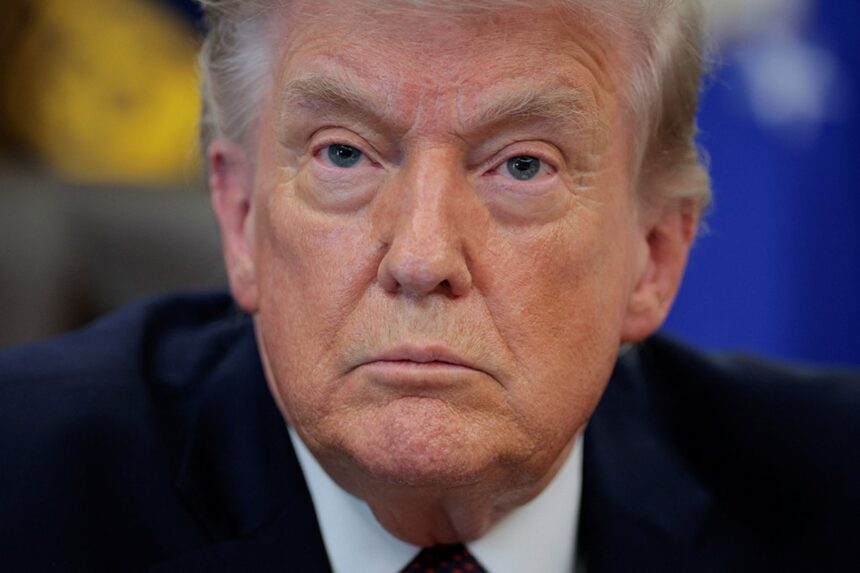
President Donald Trump issued an absolute, uncompromising ultimatum to Tehran on Wednesday, stating that the United States will not grant any immediate sanctions relief to Iran in exchange for the surrender of its highly enriched uranium stockpile.
The blunt remarks cast fresh uncertainty over complex, multi-national efforts to finalize a negotiated memorandum of understanding (MoU) aimed at bringing an end to the destructive regional war that has engulfed the Middle East over the last three months.
“Absolutely Not” — The Pivot in the Oval Office
During an exclusive, brief phone interview with PBS News, Trump flatly rejected the premise that Washington would ease its suffocating economic squeeze on Tehran simply because the Islamic Republic agrees to dismantle its immediate nuclear stockpile.
               [TRUMP'S COMPREHENSIVE ULTIMATUM TO TEHRAN]
                                    │
                                    ▼
┌──────────────────────────────────────────────────────────────────────┐
│  NO UPFRONT SANCTIONS RELIEF: Iran must surrender 100% of its highly  │
│  enriched uranium before financial or oil restrictions are eased.    │
├──────────────────────────────────────────────────────────────────────┤
│  THE BLOCKADE SUSTAINED: The U.S. naval blockade on Iranian ports    │
│  remains in effect, monitoring maritime and oil traffic.              │
├──────────────────────────────────────────────────────────────────────┤
│  THE WAR TERMINATION STAGE: The U.S. warns that if a 60-day roadmap │
│  fails, military action ("finishing the job") will resume.           │
└──────────────────────────────────────────────────────────────────────┘
When explicitly pressed on whether a tentative ceasefire framework meant Iran could swap its highly enriched uranium reserves for economic breathing room, Trump was categorical:
President Donald Trump on National Security Strategy: “No, no, not at all. Not sanctions relief, no. They’re gonna give up their highly enriched uranium, but not for sanctions relief. No, no, absolutely not.”
The Cabinet Mobilization and the Geopolitical Stakes
Following his media remarks, Trump convened an urgent Cabinet meeting at the White House to brief his administration on the fluid state of the indirect negotiations, which are being brokered through third-party regional intermediaries like Pakistan.
                    [THE DE-ESCALATION ROADMAP]
                                 │
        ┌────────────────────────┴────────────────────────┐
        ▼                                                 ▼
THE CEASEFIRE BLUEPRINT:                           THE UNRESOLVED DISPUTES:
• De-escalation overseen by a 60-day               • Iran demands upfront access to
  negotiation window.                                billions in frozen global assets.
• Gradual re-opening of the vital                 • Israel demands absolute freedom of
  Strait of Hormuz to shipping.                     action to neutralize regional threats.
While Trump had noted earlier in the week that a peace blueprint was “largely negotiated,” the details remain intensely contested. International monitors estimate that Iran possesses approximately 440.9 kilograms (972 pounds) of uranium enriched up to 60% purity—putting it a razor-thin, technical step away from weapons-grade capability ($90\%$).
Addressing the Cabinet, Trump made it clear that while Tehran is desperate to escape the devastating effects of the U.S. naval embargo, Washington will not compromise on its primary objectives:
Trump on the Progress of Indirect Talks: “Iran is very much intent; they want very much to make a deal. So far, they haven’t gotten there—we’re not satisfied with it, but we will be. We will be, either that or we’ll have to just finish the job.”
Conflicting Narratives from Washington and Tehran
The President’s public pushback appears intentionally timed to counter messaging coming out of Iranian state media channels, which had claimed that a signed draft protocol guaranteed immediate primary and secondary sanctions relief alongside a $300 billion reconstruction program.
United States and Israeli intelligence officials have continually emphasized that a complete transfer of highly enriched uranium—either via dilution on-site or direct physical delivery to the United States or a neutral third party like Russia—is a baseline prerequisite before any secondary economic relief can even be drafted.
As the 60-day diplomatic testing window hangs in the balance, U.S. Central Command confirmed that its naval blockade remains tightly enforced, with warships actively rerouting commercial vessels to ensure total compliance until an airtight, verifiable atomic settlement is reached.