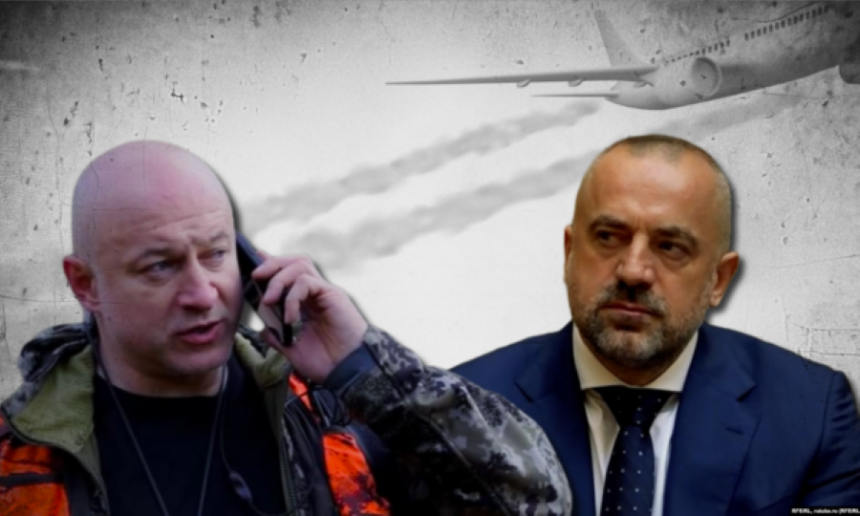
The whereabouts of Milan Radoičić and Zvonko Veselinović, two controversial businessmen from northern Kosovo with longstanding political and business connections in Serbia, remain unclear following the recent change in the country’s political landscape.
While Radoičić is wanted by Serbian authorities and faces multiple arrest warrants issued by Kosovo, Veselinović legally left Serbia and travelled to Istanbul via Sarajevo using his Serbian passport. Serbian authorities have not publicly clarified whether they know where either man is currently located.
Speculation about their possible departure from Serbia emerged following the October parliamentary elections, which ended the 14-year rule of the Serbian Progressive Party (SNS), led by former president Aleksandar Vučić.
Their apparent disappearance has raised questions about the relationship between organised crime and political power in Serbia.
“The departure of Radoičić and Veselinović raises serious questions about the depth of connections between organised crime and political power, as well as the role of individuals within Serbian state institutions,” said Saša Đorđević of the Global Initiative Against Transnational Organized Crime.
Radoičić has been under investigation since October 2023 over his alleged role in organising the armed attack in Banjska, in northern Kosovo. Prishtina has also issued several arrest warrants against him in connection with other alleged criminal offences, including war crimes in Gjakova.
Serbian authorities have also issued an arrest warrant after he failed to report to the police on November 15, as required by law.
Unlike Radoičić, Veselinović has not faced any ongoing criminal proceedings in Serbia, despite building a multimillion-euro business empire with state support. Radoičić withdrew from their business activities following the Banjska attack.
Both men have been under US sanctions for nearly five years over allegations of organised crime and corruption. They were also placed under British sanctions in 2022.
Regarding Veselinović, Đorđević said the relevant institutions should examine the serious allegations against him and determine whether there are grounds to open an investigation.
Veselinović’s journey through Sarajevo to Istanbul
The current whereabouts of Zvonko Veselinović remain unknown, but Radio Free Europe (RFE/RL) has established that he travelled to Turkey through Bosnia and Herzegovina on November 11.
Security sources in Bosnia and Herzegovina confirmed to RFE/RL that Veselinović departed Sarajevo International Airport in the early hours of the morning, using his Serbian passport.
His brother, Žarko Veselinović, who is also under US sanctions, reportedly accompanied him. The two travelled to Istanbul on a scheduled commercial flight.
It remains unclear why they left Serbia or whether Turkey was their final destination. There is also no confirmation that they subsequently travelled elsewhere.
Their departure came amid unverified speculation in parts of the Serbian public that Milan Radoičić had fled to Russia. Those claims have not been officially confirmed.
RFE/RL attempted to contact the Veselinović brothers through their construction company, Inkop, but received no response before publication.
According to the information obtained by the broadcaster, no criminal proceedings are currently underway against Zvonko Veselinović in Serbia, meaning he was legally free to leave the country.
He has faced trial twice in recent years over alleged abuses and misuse of official position. He was acquitted in both cases.
Đorđević noted that it would therefore be inaccurate to claim Veselinović had evaded prosecution in a specific criminal case. However, his departure following the political changes in Serbia raises questions about whether his position had depended on his close relationship with the previous authorities.
From Serbia to Russia: Veselinović’s hunting connections
Veselinović’s international movements have also attracted attention because of his connections to Russian hunting expeditions.
RFE/RL identified at least one trip to Russia through videos published on YouTube, showing him participating in a hunting expedition in Kamchatka in 2023.
The trip was organised by Russian hunter and blogger Dmitry Panov, who arranges hunting tours across Russia for wealthy clients and produces content for his YouTube channel and the Russian video platform Rutube.
In footage from the expedition, Veselinović appears alongside his brother Žarko and several other participants, hunting deer and bears in Russia’s Far East.
The 45-minute video, titled “Hunting in Russia”, included the description: “This time we have excellent company. Our Serbian brothers have arrived.”
Panov claimed that participants had killed two bears and 14 deer during the expedition. He also said the Serbian guests had booked another hunting trip in Russia.
Panov and his representatives did not respond to RFE/RL’s questions about their activities and connections with Veselinović. The YouTube video showing the expedition was subsequently blocked after the broadcaster submitted its questions.
Hunting expeditions in Serbia
Veselinović later returned the hospitality by hosting Panov on a hunting expedition in Serbia in March 2024.
Although the locations were not identified by name in the video, RFE/RL managed to identify three areas where the hunting took place: Morović, in northern Serbia near the Croatian border, and locations in the southwest around Raška and Mount Golija.
The expedition focused on wild boar hunting. Panov claimed that participants had killed 17 wild boars in just two days.
The Serbian movement “Kreni-Promeni” called on the relevant authorities to investigate Veselinović over allegations of illegal hunting.
In an Instagram post on November 12, the movement alleged that hundreds of wild boars had been illegally captured in traps in recent years and transferred to a fenced hunting complex in Golija linked to Veselinović.
The Forestry Directorate within Serbia’s Ministry of Agriculture, which is legally responsible for overseeing hunting activities, did not respond to RFE/RL’s questions before publication.
The public enterprise Srbijašume, which manages 27 hunting grounds across Serbia, said that no illegal activities connected to Veselinović had been recorded in the hunting areas under its administration.
Who is Russian hunter Dmitry Panov?
Dmitry Panov organises expensive hunting expeditions for wealthy clients from Russia and abroad, offering opportunities to hunt Siberian roe deer, other deer species and bears.
He describes the tours, which can cost hundreds of thousands of roubles, as a “hobby for the chosen few”.
Among his wealthy clients are reportedly millionaires with connections to the government of Russian President Vladimir Putin.
Panov has representatives in Serbia, Poland and Germany who facilitate contact with prospective clients. His representative in Serbia also did not respond to RFE/RL’s questions about his activities and relationship with Veselinović.
His hunting operations have attracted criticism from animal protection organisations over the promotion of hunts involving rare and protected species, including Kamchatka bears and snow sheep.
In March 2023, footage emerged from a hunting expedition in South Ossetia, a breakaway region of Georgia whose independence is supported by Russia. Environmental organisations said the video showed the killing of a protected brown bear, a species whose hunting is prohibited.
The footage also showed Panov being hosted at a hunting base inside a nature reserve by Alan Gagloyev, then president of South Ossetia, who is now an adviser to Putin. The meeting prompted criticism from parts of the public.
Panov has defended his activities, saying his hunts comply with relevant laws and permits. However, controversy has also surrounded the methods used during some expeditions, including tracking wild animals with helicopters and snowmobiles, as well as hunting from ambush positions near feeding sites.
His hunting base, promoted on social media, is located in Russia’s Kurgan region, near the Ural Mountains.
Such privately operated hunting grounds have also faced criticism in Russia over how permits are obtained for large areas of land and concerns that fenced-off commercial hunting facilities restrict local residents’ access to those territories.
What are Veselinović and Radoičić accused of?
A 2021 US government report providing the basis for sanctions described Zvonko Veselinović as the leader of an organised criminal group and Milan Radoičić as his deputy.
According to the report, the group was involved in the trafficking of narcotics, weapons and other goods between Kosovo and Serbia.
The report also outlined an alleged corruption scheme involving politicians who reportedly received assistance from Veselinović during election campaigns and subsequently rewarded him with lucrative infrastructure contracts.
The politicians’ names were not disclosed.
In addition to US sanctions, both men have been under British sanctions since 2022 over allegations of corruption.
While the sanctions did not result in comparable action by Serbian authorities, they legally prohibit US and British citizens and companies from conducting business with individuals and entities on the relevant sanctions lists.
Despite these restrictions, the previous Serbian government continued awarding lucrative infrastructure contracts to companies linked to Veselinović, including firms involved in road construction projects.
Kosovo authorities have also linked Radoičić and Veselinović to serious criminal offences, including the murder of Kosovo Serb politician Oliver Ivanović.
Prishtina has further accused Veselinović of organising barricades and unrest in northern Kosovo, as well as involvement in the smuggling of fuel, drugs and weapons.
Belgrade, however, has not officially pursued investigations into these allegations.
The unresolved whereabouts of the two men, particularly following the change in Serbia’s political leadership, have renewed scrutiny of their business networks, political connections and the extent of their alleged influence within Serbian institutions.