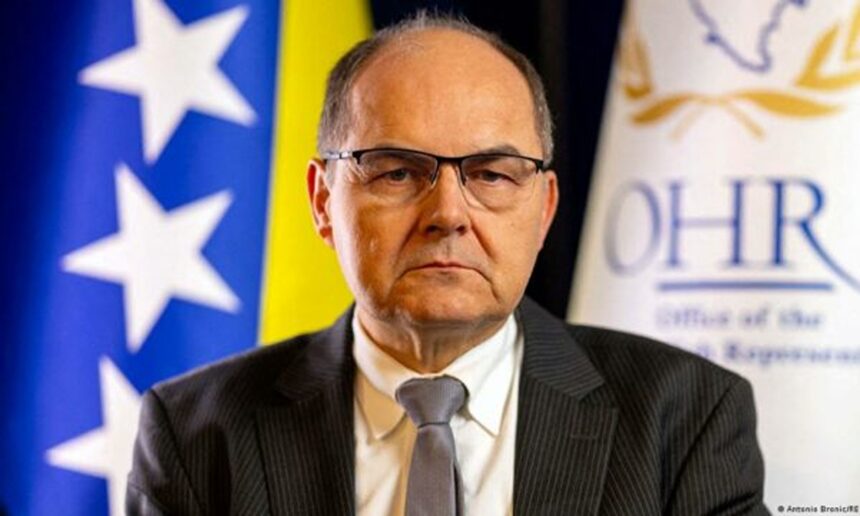
The latest session of the United Nations Security Council on the situation in Bosnia and Herzegovina was dominated by the announced resignation of High Representative Christian Schmidt, while international officials warned that his departure will not mean the end of the Office of the High Representative (OHR).
Presenting what is expected to be his final report before the Security Council, Schmidt described Bosnia’s security situation as stable but extremely fragile, warning about growing political blockages, separatist rhetoric, and deepening ethnic divisions.
He specifically criticized the leadership of Republika Srpska, led by Milorad Dodik, accusing it of continuing secessionist narratives and challenging Bosnia’s territorial integrity. Schmidt also warned that repeated failures to adopt a full state budget threaten key institutions, including the defense sector and the public broadcaster BHRT.
The session once again exposed divisions among major powers. Russia’s deputy ambassador to the UN, Anna Evstigneeva, rejected Schmidt’s legitimacy and called for the immediate closure of the OHR, accusing the institution of destabilizing Bosnia. China’s representative, Geng Shuang, allowed Schmidt to address the Council this time but maintained criticism of what Beijing called excessive foreign interference.
In contrast, representatives from the United Kingdom, the European Union, and the United States strongly defended Schmidt’s role and argued that the OHR remains necessary to preserve peace and prevent destabilization.
U.S. representative Tammy Bruce stated that the next High Representative should focus not only on maintaining stability but also on gradually transferring more responsibility to Bosnia’s local political leadership.
Meanwhile, Bosnian Presidency member Denis Bećirović condemned separatist policies from Republika Srpska as direct attacks on the Dayton Peace Agreement and Bosnia’s constitutional order. Croatian officials, however, emphasized electoral reform and the political representation of Croats in Bosnia.
As the debate unfolded in New York City, Dodik again threatened that Republika Srpska would “immediately declare independence” if Schmidt imposed a state property law before leaving office.
Analysts cited by Deutsche Welle suggest that Washington is unlikely to allow an institutional vacuum after Schmidt’s departure and may even propose its own candidate as his successor, signaling continued international oversight in Bosnia and Herzegovina.