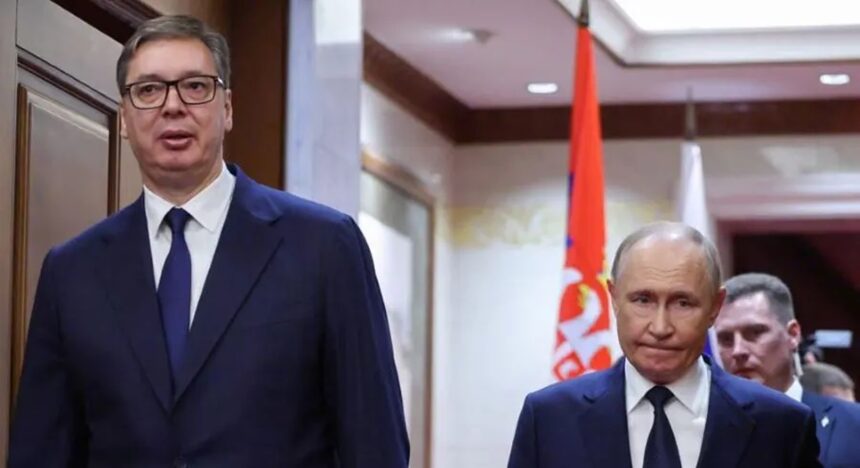
Serbian President Aleksandar Vučić said on Saturday, September 26, following a conversation with his Russian counterpart Vladimir Putin, that he was confident an annex to the agreement between Moscow and Belgrade on gas supplies would be extended, as the current arrangement is set to expire soon.
Serbia, which relies heavily on Russian gas, has failed to secure a long-term contract after its previous three-year agreement expired in the summer of 2025. Since then, the existing arrangements have been extended for shorter periods. The current agreement, which is now due to expire, was extended in June for three months.
“First and foremost, the annex to the gas supply agreement expires in a few days, and I am confident that starting Monday, that annex will be extended and that we will be able to continue having, I would say, a good and low gas price,” Vučić said in a video posted on Instagram.
He said Serbia is paying a favorable price of around €318 per 1,000 cubic meters of gas, while, according to him, the market price is €868 per 1,000 cubic meters.
Vučić said he also discussed the Petroleum Industry of Serbia (NIS) with Putin, adding that “the problem here is more complicated.”
Serbian Energy Minister Dubravka Đedović Handanović said at the end of August that negotiations over the sale of NIS between Hungary’s MOL and its largest shareholder, Russia’s Gazprom Neft, were in their final stages.
MOL and Gazprom Neft signed the main provisions of a framework agreement concerning NIS in mid-January. The U.S. administration imposed sanctions on NIS at the beginning of 2025 in an effort to prevent Russia from using revenues from the energy sector to finance its war in Ukraine. NIS now periodically seeks renewal of its license from U.S. authorities so that it can continue operating.
Appreciation for Putin
Vučić said he had informed Putin that on Sunday he would resign from the presidency of Serbia.
“On behalf of the Republic of Serbia and on my own behalf, I thanked the Russian Federation and President Putin for their cooperation over the past 14 years,” Vučić said.
Serbia, although a candidate for membership in the European Union, has refused to join Western sanctions against Russia imposed following the start of the invasion of Ukraine in 2022.
Vučić said he was “certain” that future presidents of Serbia, as he put it, “will know how to safeguard Serbia’s interests and preserve this kind of balance and this kind of responsibility toward all important actors in international politics.”
He said he and Putin discussed cooperation and relations between Serbia and Russia, the war in Ukraine, and the situation in the Balkans.
Serbia’s accession negotiations with the European Union have been stalled since 2021 due to problems related to the rule of law, its lack of alignment with sanctions against Russia, and insufficient progress toward joining the bloc.
Serbia’s ties with Russia have also raised concerns in the U.S. Congress. During a congressional hearing in mid-September, bipartisan concerns were expressed over Serbia’s relations with Russia and China, while questions were also raised about whether Moscow and Beijing’s “malign influence” had been discussed as part of the U.S.-Serbia Strategic Dialogue.