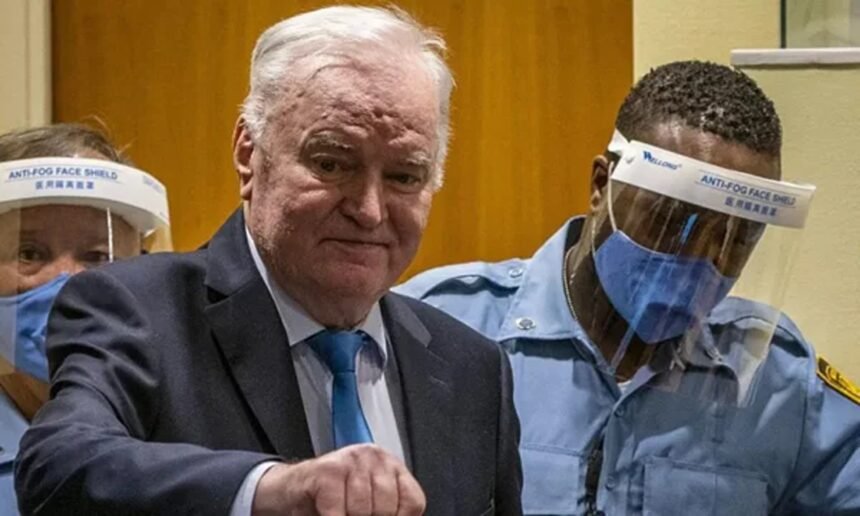
Lawyers representing convicted Bosnian Serb war criminal Ratko Mladić are awaiting a decision from a United Nations court on their request for his release from detention in The Hague, arguing that he is nearing the end of his life.
Mladić, 84, was sentenced to life imprisonment in 2017 for genocide, war crimes, and crimes against humanity committed during the wars in the former Yugoslavia between 1992 and 1995. The conviction of the man known as the “Butcher of Bosnia” was upheld on appeal in 2021, according to BBC.
In a detailed submission to the court on Friday, his lawyers said that Mladić has long been confined to a bed or wheelchair. They added that he suffered a suspected stroke during a phone call with his son, leaving him almost unable to speak.
According to the defense, two doctors have assessed his condition as severe, stating that “the risk of imminent death is high.” His lawyers have therefore requested his immediate temporary or conditional release to a hospital or hospice where Serbian is spoken.
It is understood that Mladić’s defense team is seeking his return home, and Nenad Vujić has indicated that the Serbian government is prepared to provide guarantees to the court if he is released.
Judge Graciela Gatti Santana has requested an independent medical evaluation, with findings expected to be submitted on Friday.
Mladić commanded Bosnian Serb forces in the 1990s against Bosnian Croat and Bosniak (Bosnian Muslim) forces during a war in which his troops carried out ethnic cleansing across Bosnia and Herzegovina, laid siege to the capital Sarajevo—resulting in more than 10,000 deaths—and perpetrated the massacre of over 8,000 men and boys in Srebrenica.
Mladić went into hiding in 1995 and was only captured in rural Serbia in 2011, after 16 years on the run. He went on trial in The Hague in 2012 and was convicted in 2017.
He has been held in a UN detention facility since 2011, but his lawyers argue that the unit and its prison hospital are insufficient to provide the care he needs. They claim that his continued detention constitutes “cruel and inhumane punishment” and no longer serves any legitimate purpose.
Bosniak groups representing victims and survivors strongly oppose any release, viewing it as a “legal tactic” rather than a humanitarian request. They have warned the UN court that the defense has made similar attempts over the years.
His lawyers previously sought his release in July 2025, which was denied, and later unsuccessfully requested temporary release in November 2025 to attend a family memorial.
Mladić’s son, Darko Mladić, told Serbian media that there have been no changes in his father’s health condition and that he plans to visit him at the prison hospital next week.
Judge Santana stated that medical experts have been asked to assess Mladić’s current condition, treatment options, whether his life expectancy can be determined, and whether the care he is receiving in detention is adequate.