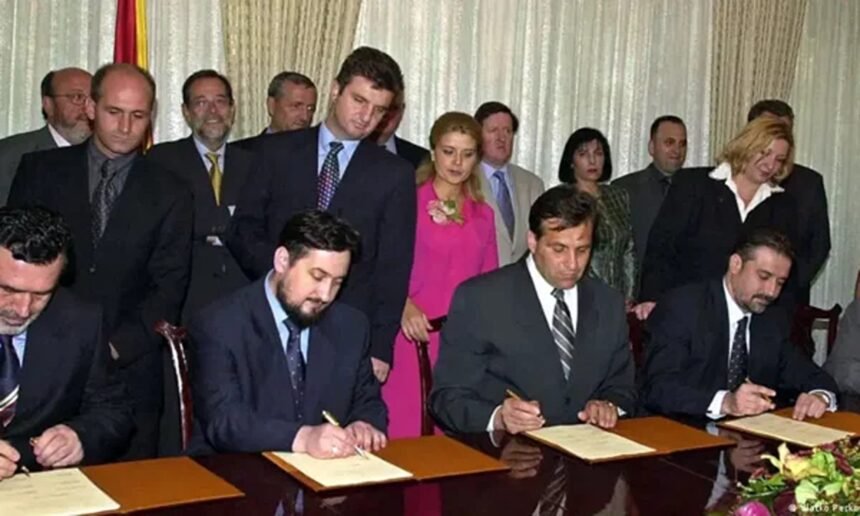
Twenty-five years after the Ohrid Framework Agreement ended the 2001 conflict in North Macedonia, analysts warn that peace between the country’s ethnic communities remains fragile.
The guns fell silent in 2001, but North Macedonia continues to grapple with the legacy of its ethnic conflict. Twenty-five years after the Ohrid Framework Agreement ended the fighting, ethnic Macedonians and Albanians live in peace, yet analysts say genuine reconciliation has still not been achieved.
The six-month conflict that erupted in February 2001 is often described as the final chapter of the violent breakup of Yugoslavia. Unlike the wars in Croatia, Bosnia and Herzegovina, and Kosovo, however, the conflict ended before developing into a larger tragedy, largely thanks to a political compromise brokered by NATO, the United States and key European Union countries.
A New Phase
A quarter of a century later, the political order created by the Ohrid Framework Agreement is entering a new phase.
Following the return of the conservative VMRO-DPMNE to power two years ago, the Democratic Union for Integration (DUI), the main Albanian political party, moved into opposition. This brought an end to two decades of governing influence by Ali Ahmeti, who transformed from a commander of the National Liberation Army (NLA) during the 2001 conflict into one of the country’s most influential political figures.
Ahmeti, who replaced his guerrilla uniform with elegant black suits and white shirts after the Ohrid Agreement, now argues that interethnic relations have deteriorated over the past two years.
“Attacks on the official use of the Albanian language, the abolition of fair and adequate representation, the weakening of mechanisms established to prevent majority rule, and the promotion of a mono-ethnic concept of the state are serious signals about the direction in which the country is moving,” he said in a statement marking August 2, North Macedonia’s national holiday.
As a country with a large Albanian minority, North Macedonia has spent much of the past 25 years trying to balance its ethnic diversity within a stable political system. According to the latest census, Albanians account for 29.5% of the population, including 24.3% of the resident population.
For Bujar Osmani, a senior DUI official and former foreign minister, the main question is no longer how much of the Ohrid Agreement has been implemented, but whether its achievements can be preserved.
“On the 25th anniversary of the Ohrid Agreement, the question is no longer only what we have implemented since 2001. The question is whether we will allow, within a few years, the dismantling of what has kept North Macedonia stable for two and a half decades,” he told DW.
2001: A Wound That Has Not Fully Healed
The legacy of the 2001 conflict continues to be deeply felt. The fighting killed 72 soldiers and police officers, while the number of Albanian insurgents killed remains disputed, with estimates ranging from around 100 to several hundred. More than 170,000 people were displaced, including 74,000 internally.
The Ohrid Framework Agreement that ended the conflict reshaped North Macedonia’s political system by establishing power-sharing mechanisms designed to give minority communities a greater voice in decision-making. Laws concerning sensitive issues such as language, education and national symbols require support not only from the parliamentary majority but also from representatives of minority groups.
Although largely aligned with European standards on minority rights, the system did not put an end to disputes over equality and representation.
“The Agreement achieved a large part of its historic mission, but its essence cannot be considered complete. Ohrid is not an administrative checklist that is completed once and then archived. It is a system of balance that must be continuously respected,” Osmani said.
Macedonian Majority Also Expresses Dissatisfaction
Different views on the legacy of the Ohrid Agreement remain at the center of the debate.
While many ethnic Macedonians argue that affirmative representation policies have created unfair advantages for Albanians, Albanian politicians say the real concern is the gradual erosion of rights guaranteed by the agreement.
“There is discrimination that concerns many people in the Macedonian community, because Albanians are often given priority in employment in order to meet representation quotas in the public sector,” said Stojanče Angelov, a police general during the 2001 conflict.
Angelov argued that such practices place ethnic affiliation ahead of qualifications.
Osmani rejects this narrative, arguing that recent government policies have weakened protections for Albanians established after the conflict.
“At first, all of this was hidden behind political propaganda, technical explanations and claims that it was simply about modernizing the system. Today, as this noise gradually fades, it is becoming much clearer what is actually being put into question,” he said.
Rising Defensive Nationalism
Local and international observers warn that years of political crises and disputes over national identity have slowed reforms and reinforced ethnic divisions.
Harald Schenker of the German NGO “Pro Peace” says the Ohrid Agreement transformed North Macedonia’s institutions, but not necessarily relations between communities.
“Ethnic distance is growing, the education system remains divided, and the two communities understand each other less and less,” he told DW.
According to Schenker, the agreement created new institutions and rules of governance but failed to promote reconciliation or a shared vision for the future.
“Each side maintains its own interpretation of what happened in 2001. Twenty-five years later, there is a need for platforms where people can openly discuss these differences. Different perspectives exist, but people need to talk to one another,” he said.
At the same time, years of stalled EU integration have fueled uncertainty about the country’s direction. North Macedonia became an EU candidate country in 2005, but accession negotiations have still not officially begun.
After resolving its decades-long name dispute with Greece, Skopje faced new obstacles stemming from Bulgaria’s demands concerning history, language and national identity.
The prolonged deadlock has not only discouraged reform efforts but has also deepened interethnic tensions, as the uncertain prospect of EU membership has weakened one of the few unifying projects shared by both Macedonians and Albanians.
Against this backdrop, questions about North Macedonia’s future remain closely linked to the legacy of the Ohrid Agreement. Next month, the country will mark the 35th anniversary of its independence from the former Yugoslavia.
Osmani does not believe the country is at risk of a new conflict, but warns that ethnic tensions could gradually increase.
“I do not believe citizens want a new problem. But ethnic tensions do not begin with conflict. They begin when a community gradually loses confidence that the system treats it as equal,” he said.
Angelov shares a similar view.
“For me, the greatest achievement is that while once we looked at each other through the sights of a rifle, today I drink coffee with some of the Albanian NLA veterans,” he said.