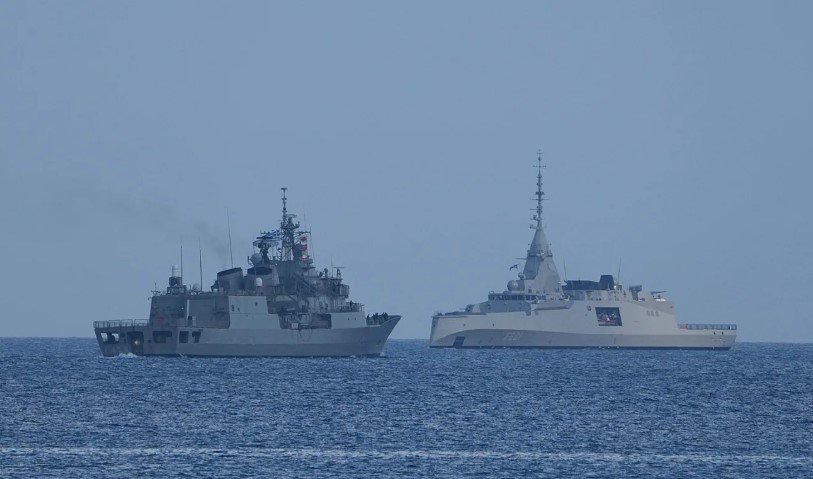
Several European countries have deployed naval and air assets to Cyprus this week, following a drone strike targeting the British RAF base in Akrotiri, in a move aimed at strengthening the island’s air defense and regional security in the Eastern Mediterranean.
The escalation came after a drone believed to be Iranian-made struck the British Royal Air Force base at RAF Akrotiri on Monday, prompting coordinated military support from European allies.
Greece deployed two frigates, Kimon and Psara, along with four F-16 fighter jets to Cyprus to bolster the island’s defensive capabilities.
France also joined the operation, sending its frigate Languedoc, equipped with advanced anti-missile and anti-drone defense systems, to support the mission.
Meanwhile, Spain announced that it will deploy its most advanced warship, the Álvaro de Bazán-class frigate Cristóbal Colón, to the Eastern Mediterranean to join French and Greek forces. The Spanish vessel had been conducting exercises with the French aircraft carrier Charles de Gaulle before the redeployment.
The Spanish frigate is expected to reach waters near Crete next week as part of the growing multinational presence in the region.
Italy is also preparing to contribute naval assets, according to Italian Defense Minister Guido Crosetto, who told parliament that Rome would follow France, Spain, and the Netherlands in supporting Cyprus’ defense efforts.
Crosetto emphasized that EU members agreed it was important to send a clear message of support for Cyprus amid rising tensions.
Cypriot President Nikos Christodoulides confirmed Italy’s participation, thanking Italian Prime Minister Giorgia Meloni in a post on X for backing the initiative.
At the same time, the Netherlands is preparing to deploy the frigate HNLMS Evertsen as part of the French aircraft carrier strike group operating in the Eastern Mediterranean.
The United Kingdom has also stepped up its military response, announcing the deployment of the Type 45 destroyer HMS Dragon along with two Wildcat helicopters armed with Martlet missiles to enhance counter-drone defenses.
The British destroyer is expected to travel approximately 5,500 kilometers, with the deployment taking about seven days to reach the operational area.
On Thursday, UK Defense Secretary John Healey arrived in Cyprus, meeting with Cypriot Defense Minister Vassilis Palmas to discuss additional measures to strengthen the island’s air defense systems.
Security concerns intensified Wednesday night when an alert siren sounded around 23:00 in Akrotiri, and authorities sent emergency notifications to mobile phones warning of a potential security threat.
However, government spokesperson Konstantinos Letymbiotis later confirmed that the alarm was precautionary, and no immediate threat was identified.
Earlier the same day, Cyprus detected a suspicious object near Lebanese airspace, prompting Greek F-16 fighter jets to scramble from Paphos Air Base. The alert was lifted more than an hour later after authorities investigated the incident.
The growing military presence highlights rising tensions in the Eastern Mediterranean, with European and NATO allies signaling readiness to defend strategic infrastructure and regional stability.