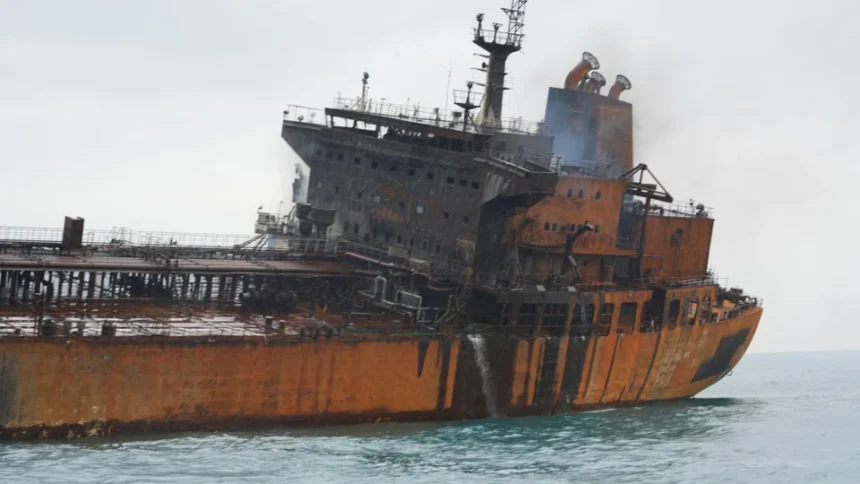
Two oil tankers were engulfed in flames at an Iraqi port on Thursday following a strike by suspected Iranian explosive-laden vessels. This marks an escalation in attacks that have disrupted oil supplies from the Middle East and challenged Donald Trump’s claim that he had won the war he initiated two weeks ago.
Verified images from Reuters, filmed from the shore of Basra port, showed ships ablaze with massive orange fireballs lighting up the night sky. Iraqi authorities blamed the attacks on Iranian ships. At least one crew member was killed.
Hours earlier, three other ships had been targeted in the Persian Gulf. The Iranian Revolutionary Guard claimed responsibility for at least one of these attacks against a Thai bulk carrier that reportedly ignored their orders. Another container ship reported being hit by an unknown projectile near the United Arab Emirates on Thursday, according to Sinjali.
The conflict, which began with a U.S.-Israel bombing campaign in late February, has so far killed roughly 2,000 people and caused what the International Energy Agency describes as the largest disruption of global energy supply in history.
Despite U.S. and Israeli claims of having destroyed most of Iran’s long-range weapons stockpiles, new drone strikes were reported Thursday targeting Kuwait, Iraq, UAE, Bahrain, and Oman. The Iranian-backed Lebanese militia Hezbollah launched its largest rocket barrage against Israel during the war, prompting new Israeli strikes in Beirut.
Oil prices climbed back above $100 per barrel, after falling earlier in the week when Trump claimed the war would soon end. Iran has warned it will block the flow of oil through the strategically crucial Strait of Hormuz along its coast until U.S. and Israeli attacks cease.
Citibank announced on Thursday it would temporarily close its branches in the UAE, a day after Iran declared banks legitimate targets and warned Middle East residents to stay 1,000 meters away. HSBC has closed its branches in Qatar.
U.S. President Trump, whose Republican Party is seeking to maintain control of Congress in elections later this year, has repeatedly tried to reassure energy markets this week, saying any price surge will be temporary.
However, he has not explained how the war will end or presented a plan to reopen the blocked strait. U.S. and Israeli officials say the goal is to destroy Iran’s missile and nuclear programs, but Trump has also demanded “unconditional surrender” from Iran and the authority to choose its leaders.
“You never like to say you’ve won too early. We won,” Trump said at a campaign-style rally in Hebron, Kentucky, on Wednesday. “In the first hour, everything was over. We had practically destroyed Iran.” He added: “We don’t want to leave too early, right? We have to finish the job.”
Inside Iran, residents report heightened security presence on the streets, signaling ongoing control by state forces.
“Security forces are everywhere, more than before. People are afraid to go out, but supermarkets are open,” said 35-year-old teacher Majan, speaking from Tehran.
Three sources told Reuters that U.S. intelligence indicates Iran’s leadership remains mostly intact and is not at immediate risk of collapse.
Israel and the U.S. have called on Iranians to rise up and overthrow their clerical rulers. Many Iranians desire change, and some openly celebrated the death of Supreme Leader Ayatollah Ali Khamenei on the first day of the war, though no organized anti-government activity has been reported amid ongoing attacks.
Iran has made it clear in the last two days that its strategy is now to impose prolonged economic shocks to compel Trump to withdraw. An Iranian military spokesperson warned Wednesday that the world should prepare for oil prices of $200 per barrel, surpassing the historical high of $147.27 in July 2008.
Thursday’s price surge came despite the previous day’s announcement that developed countries would release 400 million barrels from strategic reserves, nearly half from the U.S. This is widely seen as the largest coordinated intervention in oil markets ever. Trump said it would “significantly lower oil prices while ending this threat to America and the world.”
However, the release will take months and only cover about three weeks of supply from the blocked strait. Futures contracts for two and three months ahead suggest traders expect prices to fall over the coming months, but much more slowly than anticipated just days ago.
“The only way to see oil prices trade sustainably lower is to allow oil to flow through the Strait of Hormuz,” ING analysts said. “If this does not happen, it means peak market levels are still ahead of us.”