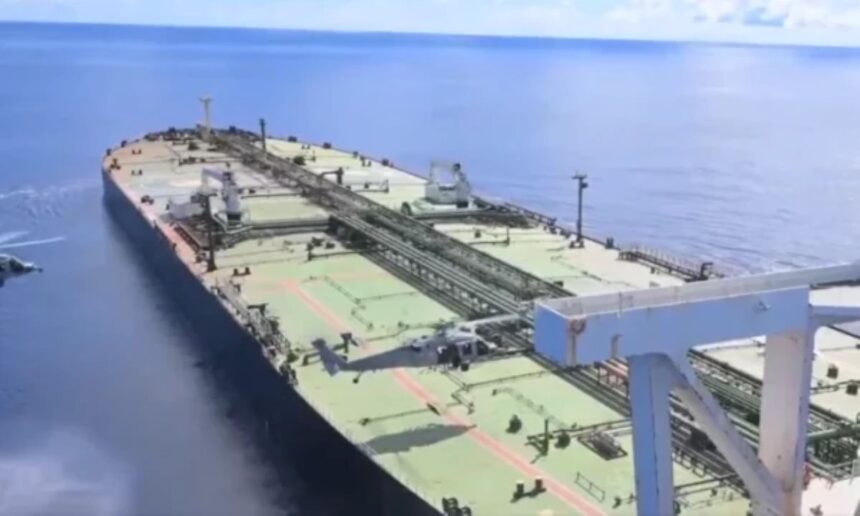
In a major escalation of the ongoing maritime standoff, U.S. forces have intercepted and boarded a sanctioned vessel in the Indian Ocean. The U.S. Department of Defense confirmed via the social media platform X that the stateless tanker, M/T Majestic X, was caught transporting Iranian crude oil in violation of international sanctions.
The operation, described as a “maritime interdiction and right-of-visit board,” signals a strategic expansion of the U.S. naval blockade beyond the immediate vicinity of the Persian Gulf.
Extending the Blockade: From Hormuz to the Indian Ocean
While much of the global attention has been focused on the Strait of Hormuz, the seizure of the Majestic X proves that the U.S. “Maximum Pressure” campaign has moved deep into international waters. By targeting ships in the Indian Ocean, the U.S. Navy is cutting off the “long-haul” smuggling routes used by Tehran to reach markets in Asia and Africa.
- The Tactic: A “right-of-visit” board is a high-stakes legal and military maneuver used to inspect vessels suspected of being stateless or engaging in illicit activities.
- The Message: The Pentagon stated clearly that the military will continue to intercept any vessel suspected of “providing material support to Iran.”
The Global Energy Stranglehold
The seizure of the Majestic X adds further pressure to an already volatile global energy market. With the Strait of Hormuz remaining closed and the U.S. aggressively hunting tankers across the Indian Ocean, the Iranian regime’s ability to generate oil revenue is hitting a historic low.
Strategic Implications:
- Economic Paralysis: Every intercepted tanker represents tens of millions of dollars in lost revenue for Tehran, further destabilizing a regime already struggling under a total naval blockade.
- Risk to Shipping: The Indian Ocean, once a safe transit zone for oil, has now become an active theater of “shadow war” between the U.S. Navy and the “ghost fleet” of sanctioned tankers.
- Diplomatic Stalemate: This interception occurs just as the White House confirmed that President Donald Trump has set no fixed deadline for a ceasefire, opting instead to maintain pressure until Iran surrenders its enriched uranium.
Since the conflict began in late February 2024, the U.S. has detained dozens of vessels. However, the shift toward the Indian Ocean suggests that the “ghost fleet”—ships that fly “flags of convenience” or operate without nationality—is being systematically dismantled.