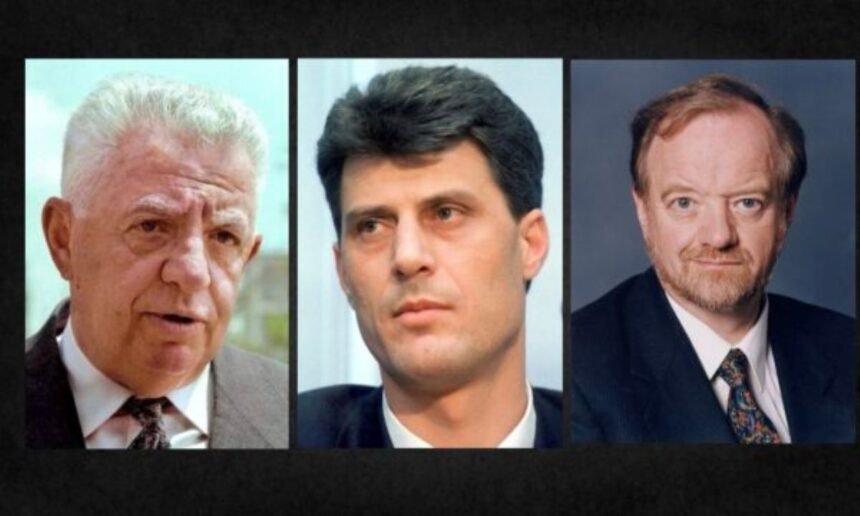
On May 6, 1999, at the height of the Kosovo War, Serbian forces executed Professor Fehmi Agani, the vice-president of the Democratic League of Kosovo (LDK) and a key figure in the Rambouillet peace negotiations. Newly resurfaced reports from the New York Times archive detail how the Yugoslav government attempted to orchestrate a disinformation campaign to blame the Kosovo Liberation Army (KLA) for the assassination—a narrative that was swiftly dismantled by the international community.
The Abduction from the Refugee Train
According to accounts provided to the New York Times by family members at the time, Professor Agani was forcibly removed from a train by Serbian police near Lipjan. Agani, along with his wife and son, had attempted to flee to Macedonia after the border at Bllacë was temporarily closed.
“Serbian police officers stopped the train during its return to Pristina and detained Mr. Agani, but allowed his wife and son to proceed,” the report stated. When Mrs. Agani later visited the Pristina police headquarters seeking information, she was forced to leave without an explanation. His body was discovered shortly thereafter.
The Failed Serbian Propaganda
Immediately following the murder, the Yugoslav state news agency, Tanjug, issued a statement alleging that Agani had been killed by the KLA. The agency claimed that the “Albanian rebels” had executed the moderate leader to consolidate power.
However, this version of events was categorically denied by:
- The Agani Family: Who witnessed his arrest by uniformed Serbian officers.
- Hashim Thaçi: Then-political leader of the KLA, who spoke to the NYT via satellite phone from Kosovo, stating the murder was an attempt to “destroy the political unity of Kosovo Albanians.”
- The German Foreign Ministry: Which backed the KLA’s claims, confirming that Agani had died while in Serbian police custody and calling for an independent investigation.
International Outrage
The assassination of a moderate leader like Agani—who was seen as a bridge-builder between various political factions—sent a clear message to Western capitals. Then-British Foreign Secretary Robin Cook addressed the incident as a prime example of the “terror and brutality” that justified the ongoing NATO military campaign.
“If he was killed by the Serbian police, as the family believes, it is the latest example of brutality and slaughter. This is why we are conducting a military campaign,” Cook told the NYT in May 1999.
A Strategic Target
Political analysts at the time noted that by killing Agani and attempting to frame the KLA, Belgrade hoped to spark an internal civil war between the “moderates” (LDK) and the “guerrillas” (KLA). Professor Agani was a founding member of the LDK and a close associate of Ibrahim Rugova, but he was also highly respected by the KLA leadership for his intellectual contribution to the national cause.
The failure of the Serbian disinformation campaign ultimately backfired, as Western diplomats used Agani’s death as evidence of the “ethnic cleansing” and state-sponsored terror that defined the Milošević regime’s strategy in Kosovo.