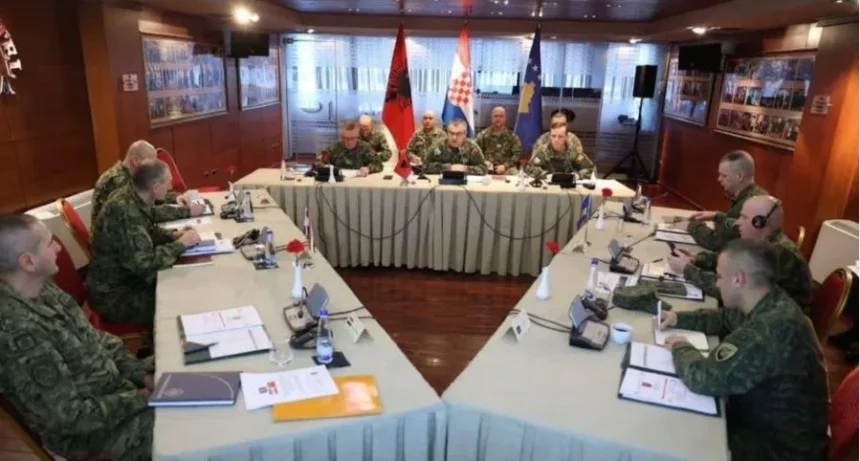
Serbian President Aleksandar Vučić has intensified his rhetoric against a regional defense pact, specifically targeting Croatia as the primary architect behind the strategic cooperation between Prishtina, Tirana, and Zagreb.
In an interview with the Belgrade-based tabloid Informer on Wednesday evening, Vučić questioned the motives behind the alliance, which he views as a direct threat to Serbian interests.
The “Zagreb Initiative” Allegations
Vučić claimed that Serbian intelligence services have confirmed that the tripartite alliance was formed at the persistent request of official Zagreb.
“We will never get an answer as to why they founded that alliance. Tell us, why did you do it?” Vučić stated. “From intelligence circles, we have information that the alliance was formed on the initiative of Zagreb. They insisted on it. Why?! Why do they protect people who caused chaos in Serbia and are charged with terrorism?”
The Nature of the Tripartite Agreement
The agreement in question is a security and defense cooperation declaration signed in March 2025. While Belgrade labels it an “offensive military alliance against Serbs,” the participating nations frame it as a stability-oriented partnership.
Key Pillars of the Cooperation:
- Defense Industry: Promoting joint capabilities and defense industrial cooperation.
- Interoperability: Increasing military synergy through joint education, training, and exercises.
- Hybrid Threats: Addressing cyber warfare, disinformation, and strengthening national resilience.
- Euro-Atlantic Integration: Providing full support for Kosovo’s path toward NATO and EU membership.
- Joint Procurement: Plans for coordinated purchases of advanced weaponry from the United States.
Diplomatic Rebuttals
The signatories—Croatia and Albania (both NATO members) and Kosovo—have consistently maintained that the pact is defensive and not aimed at any specific country.
In a notable diplomatic twist, Albanian Defense Minister Pirro Vengu stated in January 2026 that Serbia had been invited to join the pact to foster regional transparency, but Belgrade chose not to respond to the invitation.
Analysis: Regional Power Shifts
The alliance represents a significant shift in Balkan geopolitics. By aligning their defense procurement and training, the “Adriatic-Balkan” trio seeks to create a standardized military bloc compatible with NATO standards. For Vučić, the involvement of Croatia—a former Yugoslav republic with a complex historical relationship with Serbia—adds a layer of deep-seated political friction to what the signatories describe as a modern security necessity.
The plan for joint purchases of American armaments suggests a long-term strategy to decouple regional defense reliance from non-Western suppliers, further isolating Serbia’s current “military neutrality” policy.