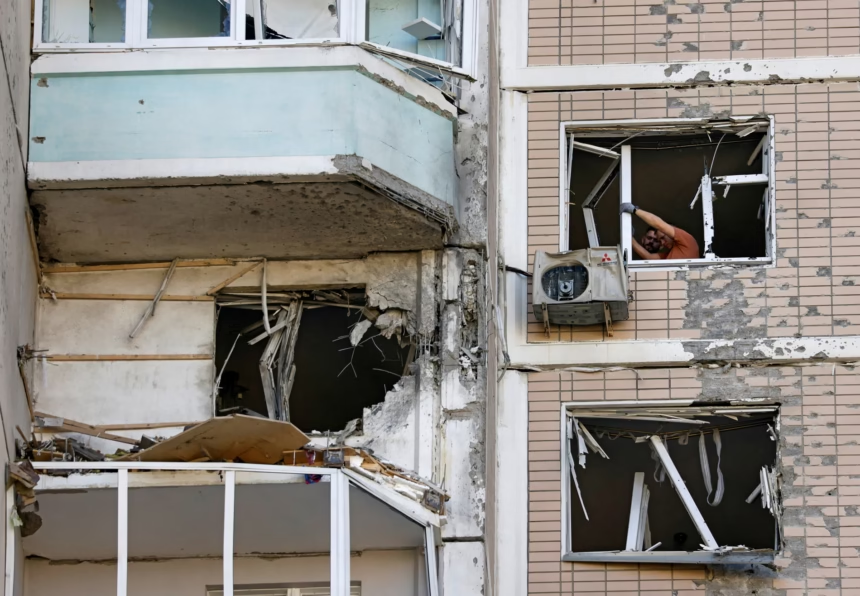
In one of the largest coordinated drone assaults since the onset of the conflict, Ukraine launched nearly 600 drones overnight targeting 14 Russian regions, including a rare mass strike on the capital, Moscow. Russian authorities confirmed that the strikes killed at least four people and left dozens injured.
According to the Russian Ministry of Defense, Ukraine deployed an estimated wave of 596 drones across the country, as well as over the occupied Crimean peninsula, the Black Sea, and the Sea of Azov. Russian air defense systems reportedly intercepted 556 drones during the night and neutralized an additional 30 after dawn.
Kyiv Frameworks Strikes as Justified Retaliation
Ukrainian President Volodymyr Zelenskyy confirmed the operation, stating that the domestically produced drones traveled more than 500 kilometers (310 miles) from the Ukrainian border. Zelenskyy noted that Ukrainian forces successfully bypassed heavy Russian air defense networks concentrated around the capital.
“Our response to Russia’s continuation of the war and its ongoing strikes against our cities and communities is fully justified,” President Zelenskyy stated. He added that striking deep inside Moscow sends a clear signal to Russian citizens that “their state must bring its war to an end.”
The operation follows a warning from Zelenskyy last week that Kyiv would retaliate for a devastating three-day Russian bombardment across Ukraine that killed over 20 civilians and wounded roughly 50 others.
Casualties and Infrastructure Damage in the Moscow Region
Moscow Regional Governor Andrei Vorobyov described the attack on the capital region as “massive.” While the metropolitan center itself avoided catastrophic damage, the surrounding areas saw significant impacts:
- Khimki (North of Moscow): A residential home was struck, killing one woman. Emergency crews continue to search the rubble for an additional missing person.
- Pogorelki (6 miles north of Moscow): Two men were killed at a construction site after being struck by falling drone debris. An Indian national was confirmed among the deceased by the Indian Embassy in Moscow.
Moscow Mayor Sergei Sobyanin reported that over 80 drones were intercepted directly over the city limits. Twelve injuries were recorded, alongside minor property damage from falling shrapnel.
Notably, debris hit an area near the Moscow Oil and Gas Refinery, injuring construction workers and damaging three homes. Sobyanin claimed that the refinery’s main technological infrastructure remained unaffected and production was not halted.
However, Ukraine’s Security Service (SBU) offered a different assessment, asserting that the refinery and two critical pumping stations around Moscow were successfully compromised.
“These strikes systematically reduce the enemy’s economic capacity to sustain its war machine,” an SBU official stated, adding that the operation proves “even the heavily fortified Moscow region is no longer safe.”
Baltic Airspace Breached Amid Electronic Warfare
The fallout from the massive drone wave rippled into neighboring NATO territory on Sunday, highlighting the persistent danger of stray munitions and electronic jamming.
A suspected Ukrainian military reconnaissance drone crashed in Lithuania after crossing the border undetected. Vilmantas Vitkauskas, head of Lithuania’s National Crisis Management Center, confirmed the unarmored and unarmed drone was recovered near the village of Samane, close to the Belarusian and Latvian borders.
Concurrently, Latvia issued a tactical drone alert along its border with Russia, prompting NATO Baltic Air Policing fighter jets to scramble. Military officials confirmed a drone briefly breached Latvian airspace before exiting.
Kyiv has previously acknowledged that while its long-range drones are precisely programmed to strike military infrastructure inside Russia, intense Russian electronic warfare (EW) and GPS-spoofing frequently cause malfunctioning aircraft to drift off-course into neighboring Baltic states.
The geopolitical strain of these airspace violations was highlighted on May 7, when stray drones triggered a fire at a Latvian oil depot, a security failure that ultimately led to the resignation of the Latvian Defense Minister and the subsequent collapse of the country’s government on May 14.
Diplomatic Deadlock Continues
The intense escalation marks a definitive end to last Tuesday’s brief, failed three-day ceasefire—which both sides accused the other of violating—intended to mark the anniversary of Victory in Europe Day.
Diplomatic channels remain completely frozen. Kyiv continues to reject Moscow’s territorial demands in the Donbas region, while international diplomatic attention has increasingly shifted toward the parallel conflict involving the United States, Israel, and Iran.