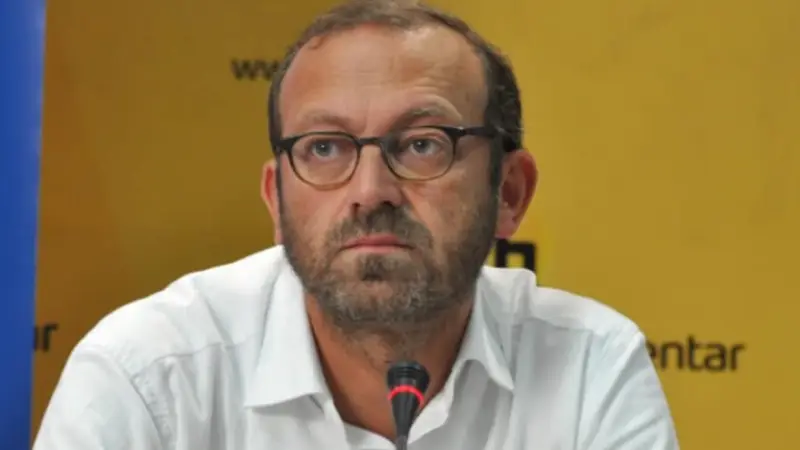
Prominent Kosovar journalist and political analyst Enver Robelli has issued a sharp critique of the recent memorandum published by protesting student groups in Serbia. Robelli warns that a movement which initially sparked as a civic revolt against state corruption and institutional negligence is rapidly devolving into extreme nationalism, echoing the dangerous rhetoric of the 1990s.
In his latest analysis, Robelli argues that the newly released student manifesto bears alarming structural similarities to the infamous 1986 Memorandum of the Serbian Academy of Sciences and Arts (SANU)—the historical document widely recognized as the ideological blueprint for Slobodan Milošević’s aggressive nationalist policies.
Echoes of the 1986 SANU Memorandum
According to Robelli, the demonstrating students are utilizing rhetoric that incites regional friction, noting that their geopolitical posture regarding Kosovo remains virtually indistinguishable from the “racist dogmas of their ideological forefathers.”
He sharply criticized the student manifesto for framing Kosovo exclusively as an abstract anchor of Serbian national identity while completely erasing the existence of the ethnic Albanian majority currently living there.
“Twenty-seven years after the withdrawal of Serbian forces from Kosovo and 18 years after Kosovo’s declaration of independence, these Serbian students remain so completely detached from geopolitical reality that they are actively propagandizing the return of Serbian state authority over Kosovo,” Robelli observed.
From Civic Grievance to Far-Right Drift
Robelli traced the evolution of the protests, recalling that they originally possessed a legitimate, anti-corruption focus. The movement initially mobilized following the November 1, 2024 infrastructure disaster in Novi Sad, where 16 people were killed when a concrete canopy collapsed at the city’s newly renovated railway station.
However, Robelli notes that this civic momentum has been systematically hijacked by right-wing elements. He pointed specifically to a massive rally held in Belgrade on June 28 (Vidovdan), which was entirely dominated by ultranationalist chanting and revisionist historical references to the 1389 Battle of Kosovo.
Intellectual and Theological Influences
The analyst further highlighted the mainstreaming of controversial historical and contemporary figures among the student protestors, pointing to two specific influences:
- Nikolaj Velimirović: A twentieth-century Serbian Orthodox theologian whom Robelli characterizes as a staunch anti-Semite and an historical admirer of Adolf Hitler.
- Milo Lompar: A contemporary literature professor renowned for his hardline nationalist views and his vocal advocacy for the concepts underpinning the contemporary “Serbian World” (Srpski svet) geopolitical doctrine.
Robelli concluded his analysis with a stark warning, framing this new student memorandum as a direct ideological continuation of the 1986 text that paved the way for continental tragedy.
“The core theses of the 1986 memorandum served to directly legitimize Milošević’s expansionist wars in Croatia, Bosnia and Herzegovina, and finally, Kosovo. Seeing the youth repeat these patterns is a dangerous indicator for the future of regional stability,” Robelli emphasized.