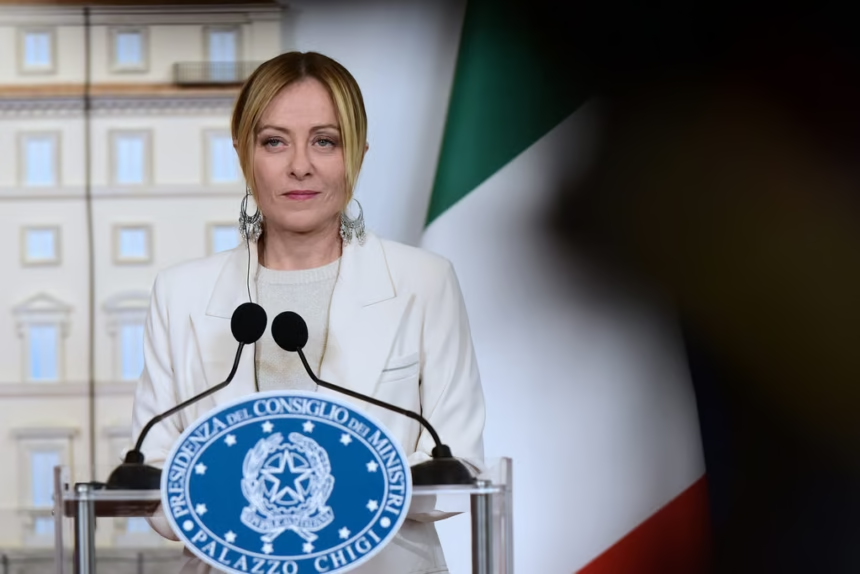
Italian Prime Minister Giorgia Meloni is intensifying pressure on Brussels to loosen the European Union’s fiscal rules, arguing that emergency spending required to absorb the economic shocks of the war in Iran and soaring energy prices should be exempted from deficit calculations.
In a formal letter to European Commission President Ursula von der Leyen—first reported by Italy’s Corriere della Sera newspaper on Monday—Meloni requested that “investments and extraordinary measures needed to address the energy crisis” be excluded from the bloc’s Stability and Growth Pact. The fiscal framework strictly mandates that EU member states maintain national budget deficits below 3 percent of GDP.
“The crisis in the Middle East and the tensions in the Strait of Hormuz, which add to the effects of the Russian aggression in Ukraine, are already having very heavy and often asymmetrical effects on energy prices, on the costs for families and businesses,” Meloni wrote.
The Italian premier argued that energy security has become a European strategic priority on par with continental defense. She insisted that because the stability agreement already grants accounting exemptions for defense expenditures, a similar mechanism must be applied to emergency energy costs.
Meloni raised the stakes by warning that Rome would struggle to justify its participation in the EU’s SAFE defense financing program if Brussels refuses to grant flexibility for energy spending. Specifically, Italy is demanding that the bloc’s existing “national safeguard clause”—currently reserved for defense investments—be temporarily expanded to encompass emergency energy measures.
The diplomatic push comes at a highly fraught moment for Meloni’s domestic agenda. Last month, the EU’s statistical body confirmed that Rome’s 2025 budget deficit had breached Brussels’ fiscal threshold. Coupled with a recent major defeat in a domestic justice referendum, the fiscal violation threatens to force spending cuts on the government just ahead of a delicate election year, where Meloni’s center-right coalition remains locked in a dead heat with center-left rivals.
Europe’s energy sector has been in turmoil since February 28, 2026, when war erupted in the Middle East following joint U.S.-Israeli strikes on Iranian targets. The conflict has triggered skyrocketing energy prices, refinery disruptions, and critical anxieties regarding gas and jet fuel supplies, exacerbated by threats to the Strait of Hormuz—a maritime chokepoint through which roughly 20 percent of the world’s oil supply passes.
Despite the mounting economic pressure, Brussels has continually resisted sweeping policy interventions. Earlier this year, the European Commission rebuffed a joint request from Austria, Germany, Italy, Portugal, and Spain to implement a windfall tax on energy companies profiting from the war.
The Commission signaled a similarly firm stance against Meloni’s latest appeal. In a statement to Italian media, Commission spokesperson Olof Gill stated that while the EU has provided member states with “a range of options” to mitigate the crisis, the bloc is “not including the National Safeguard Clause among these options,” reiterating its commitment to a “framework of fiscally responsible constraints.”