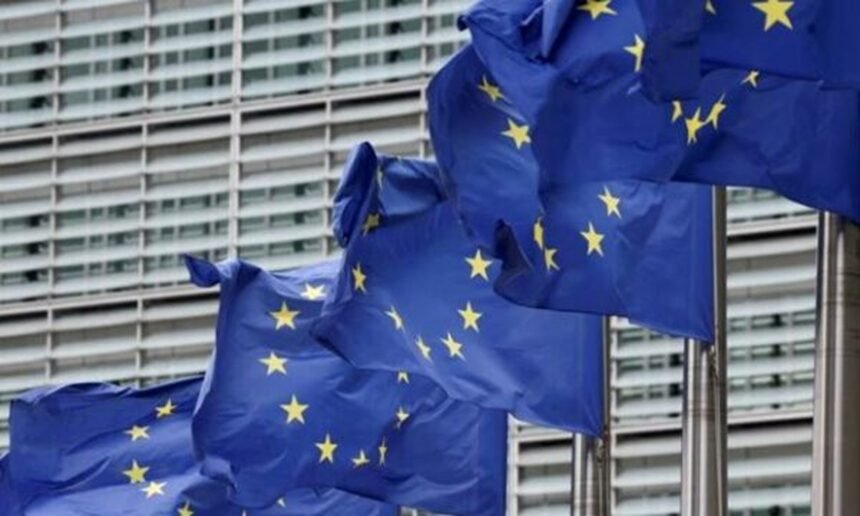
The European Union may strip future member states of the right of veto for several years, in an effort to make enlargement more politically acceptable, as the bloc pushes to admit new countries before the end of this decade.
According to plans being considered by the European Commission, candidate countries for EU membership, such as Moldova and Western Balkan states, would not automatically have the right to block foreign policy decisions or other matters decided by unanimity, such as taxation, immediately after joining the EU.
The idea is particularly relevant for Montenegro, the frontrunner among nine official candidate countries for EU membership. The former Yugoslav republic with 624,000 inhabitants aims to become the EU’s 28th member state by 2028. This month, a technical group tasked with drafting Montenegro’s accession treaty met for the first time, a sign that the 14-year-long negotiations are entering their final phase.
In this context, EU officials are considering safeguard measures for new member states, in order to prevent decision-making being blocked by a single member state, according to four EU sources. The idea emerged after the difficult experience with Hungary, where the former pro-Russian government led by Viktor Orbán vetoed several major EU decisions, including a €90 billion loan for Ukraine.
A temporary suspension of veto rights could be included in Montenegro’s accession treaty and then serve as a model for other countries waiting in line.
This measure is considered legally at the edge of what is acceptable and could only be applied temporarily, in order to avoid creating second-class members within the EU.
In a separate development, German Chancellor Friedrich Merz wrote to EU leaders last week calling for “innovative solutions” to speed up EU accession for Western Balkan countries. In the letter, which described EU enlargement as a “geopolitical necessity,” Merz also called for “associated membership for Ukraine” as a “decisive step on Ukraine’s path toward full membership.”
Associated membership for Ukraine would mean participation in EU meetings and representation in the bloc’s institutions without voting rights. According to Merz, the German proposal “reflects the special situation of Ukraine, a country at war” and would “facilitate ongoing peace negotiations.”
Ukrainian President Volodymyr Zelenskyy rejected the idea.
“Ukraine’s place in the European Union must be full, equal, and with full rights,” he wrote on social media after Merz’s letter became public.
EU enlargement had nearly stalled until Russia’s full-scale invasion of Ukraine in 2022 gave new urgency to negotiations with eastern neighbours. The European Commission said last year it could admit new members by 2030, identifying Montenegro and Albania as frontrunners, while also noting Moldova’s rapid progress and suggesting that EU membership could serve as a security guarantee for Ukraine.
Delaying veto rights is only one of several safeguard measures being discussed to make enlargement more acceptable.
Existing EU member states must unanimously agree on admitting new members. Officials are particularly concerned about ratification in France, where presidential elections will be held in 2027 and scepticism towards EU enlargement is growing.
EU sources argue that creative thinking is needed to achieve enlargement, especially in the Western Balkans, a region of 17.4 million people where Russia and China are trying to increase their influence.
A senior EU diplomat said the veto delay is one of the “constructive solutions” being considered as part of a process of “creative thinking” on enlargement.
Meanwhile, Germany has led efforts for internal EU reforms, such as removing veto power in foreign policy, out of concern that a union of more than 35 member states would be paralysed by political blockages.
German Foreign Minister Johann Wadephul said earlier this month that “a union with 33, 34 or 35 member states cannot continue to function with the same approach designed for a much smaller group.”
However, the EU executive fears that waiting for consensus on internal reforms, which could require treaty changes, could push enlargement further down the agenda.
For candidate countries, Ukraine is considered a special case due to its size, the war with Russia, and the massive reconstruction costs. The total cost of rebuilding Ukraine was estimated at $588 billion as of 21 December 2025, three times its economy.
EU officials believe Ukraine could technically complete the accession process within four years, but the entry date is seen as a political issue tied to a peace agreement.
Engjellushe Morina, senior researcher at the European Council on Foreign Relations, said a temporary veto suspension “is not that drastic” and would be used by politicians to make enlargement more acceptable.
“I would not be surprised if we see something like this in Montenegro’s treaty. It would serve as a model for new members. Politicians will say: ‘we are introducing safeguards and showing caution.’ That is the logic,” she said.
The idea also aims to protect the Union from the possibility of a new member state changing political direction after accession, for example if a pro-Russian government comes to power in Montenegro.
A source from the Montenegrin government said the country’s objective remains full EU membership, “with all the rights and responsibilities that come with the status of an equal member state,” adding that Montenegro “does not oppose safeguard mechanisms and believes they can play a constructive role in ensuring the sustainability of reforms even after accession.”