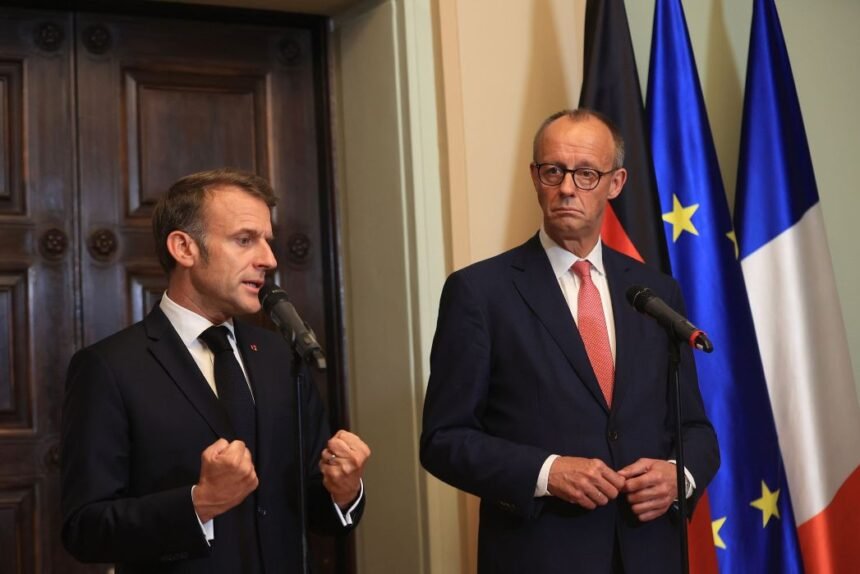
French President Emmanuel Macron and German Chancellor Friedrich Merz held a critical summit in Germany on Friday, focused squarely on tightening bilateral defense and security cooperation.
The meeting comes on the heels of a major industrial setback: the total collapse of the Future Combat Air System (FCAS), their ambitious multi-billion-euro joint project to develop a next-generation stealth fighter jet.
Symbolic Settings and New Targets
The high-stakes diplomacy began at the Nörvenich Air Base near Cologne, a vital hub for tactical military aviation.
Following the airfield briefings, the delegations relocated to a historic castle loaded with diplomatic resonance. It was at this same location in 1962 that French President Charles de Gaulle and German Chancellor Konrad Adenauer laid the foundational stones of the modern Franco-German partnership.
Seeking to salvage their military alliance, Macron and Merz announced plans to establish a joint steering group to shift their focus away from the failed fighter jet and toward alternative, immediate military integrations:
- Advanced radar systems integration.
- The co-development of long-range missiles.
- Coordinated continental missile defense architecture.
A Tense Geopolitical Backdrop
President Macron emphasized his desire to inject a “new dynamic” into continental defense, reinforcing his long-standing vision for a highly autonomous Europe capable of securing itself independently. This push for self-reliance is accelerated by three converging pressures:
- The Russian Threat: Continual security challenges and military escalation on Europe’s eastern flank.
- Washington Uncertainty: Shifting political dynamics in the United States, raising questions regarding the long-term American commitment to NATO’s defensive umbrella.
- Domestic Pressures: The looming French presidential elections, where right-wing populist leader Marine Le Pen remains a frontrunner.
Persistent Strategic Divides
Despite the public show of unity, deep-seated industrial and tactical differences continue to strain the Paris-Berlin axis, particularly regarding airspace security:
| Country | Preferred Strategic Path | Underlying Rationale |
| Germany | Backs the European Sky Shield Initiative (ESSI). | Prioritizes rapid deployment by purchasing existing off-the-shelf defense systems from the US and Israel. |
| France | Strongly opposes ESSI membership. | Insists Europe must build its own industrial defense base instead of buying ready-made American equipment. |
Beyond pure defense hardware, the two leaders also mapped out strategies to boost EU economic competitiveness, negotiate the upcoming bloc budget, combat coordinated foreign disinformation networks, and launch collaborative initiatives in artificial intelligence to prevent Europe from falling permanently behind the US and China.