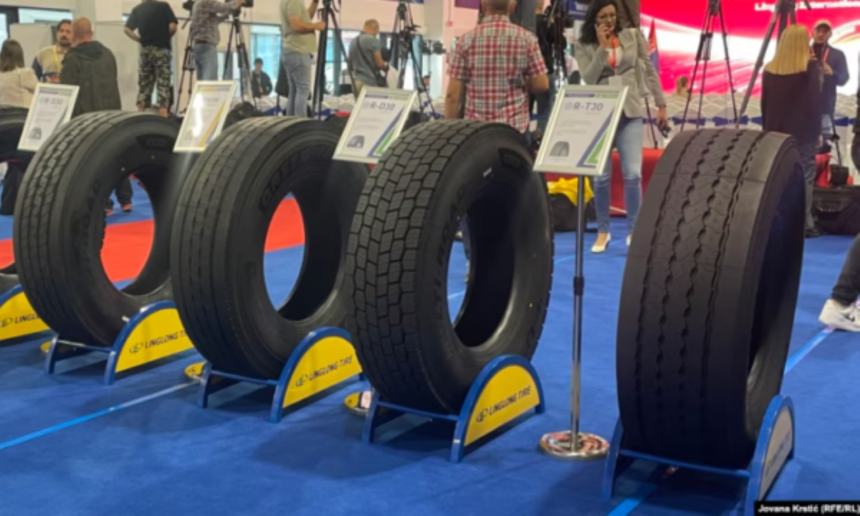
A regional investigative report published by Radio Free Europe (RFE) has exposed a major regulatory conflict in northern Serbia, revealing that the provincial government of Vojvodina bypassed mandatory safety protocols to grant operating permits for highly hazardous sections of the Chinese-owned Linglong tire factory in Zrenjanin.
According to official documents uncovered by RFE, the Provincial Secretariat for Construction issued usage permits for critical and environmentally sensitive infrastructure within the industrial complex—including active chemical mixers, raw material warehouses, and designated storage zones for highly reactive sulfur and carbon black.
The provincial override took place without the plant securing mandatory environmental and defense approvals aimed at preventing and managing large-scale industrial disasters.
The Regulatory Crack: Zrenjanin’s Refusal vs. Vojvodina’s Approval
The factory’s operating status has triggered a direct bureaucratic battle between local municipal regulators and the higher provincial administration, revealing a fractured enforcement of environmental law in Serbia.
- The Local Authority Block: Under standard building codes, the Zrenjanin municipal administration reviewed and systematically rejected all of Linglong’s usage applications submitted between December 2025 and May 2026. The city ruled that because the plant handles massive volumes of hazardous materials, it is legally classified as a “Seveso” high-tier hazard facility. Consequently, the city maintained that no commercial permits could be granted until the central Ministry of Environmental Protection formally approved the factory’s long-delayed disaster management plan.
- The Provincial Override: In sharp contrast, just 24 hours after the city issued its first formal rejection citing incomplete safety paperwork, the Provincial Secretariat for Construction in Vojvodina stepped in to grant usage approvals for the complex’s most volatile technological units (mixers and sulfur silos).
Crucially, the provincial decree omitted any mention of Linglong’s classification as a high-tier Seveso facility, treating the interconnected factory components as isolated, low-risk structures.
Understanding the Seveso Directive Violations
The “Seveso” classification originates from European Union environmental frameworks adopted into Serbian law, designed to regulate industrial plants that house dangerous chemical thresholds capable of triggering catastrophic toxic leaks, explosions, or environmental failure.
[Seveso Statutory Compliance Chain]
  1. Factory Chemicals Declared (Sulfur/Carbon Black Volumes)
             │
             ▼
  2. Submission of Safety Report & Emergency Action Plan
             │
             ▼
  3. Ministry of Environmental Protection Verification (PENDING)
             │
             ▼
  4. Final Commercial Usage Permits Issued (Bypassed by Vojvodina)
Independent environmental consultant and industrial risk evaluator Dušan Blagojević emphasized that the provincial government’s fragmented approval mechanism directly violates basic chemical safety legislation.
“We are dealing with a massive integrated industrial zone featuring highly interdependent technological units: raw material handling, component mixing, vulcanization, and energy blocks,” Blagojević explained to RFE. “All of these operate under a single operator at a single geographic location. Therefore, statutory safety obligations must be determined and enforced across the entire complex, not handed out piecemeal for separate buildings.”
Blagojević underscored that under explicit Serbian law, no segment of a Seveso-classified facility is legally permitted to pass technical inspection or begin commercial production without an active, validated Safety Report and a certified Emergency Protection Plan approved by the state.
Shifting Data and Confidential Inspections
The investigation also highlighted significant discrepancies in Linglong’s environmental declarations over time:
| Chronological Phase | Declared Safety Status by Linglong | Actual Operational Profile |
| 2020 (Initial Environmental Impact Studies) | Claimed hazardous chemicals would be kept at minimal levels; insisted plant would not trigger Seveso classification. | Secured early construction approvals based on low-risk declarations, avoiding initial strict oversight. |
| December 2025 – Present | Formally registered in Serbia’s official Seveso database; admitted to storing high-risk volumes requiring emergency plans. | Attempting to retroactively legalize mass production while running chemical mixers without validated disaster protocols. |
“Looking back, it is highly evident that Linglong originally submitted incomplete documentation to secure its initial environmental impact clearances in 2020,” Blagojević noted. “Those initial papers should have contained rigorous toxic accident consequence modeling from day one.”
Compounding the lack of transparency, the Provincial Secretariat for Construction actively refused to release copies of the factory’s technical inspection reports to investigative journalists, defying a formal disclosure directive from the state Commissioner for Information of Public Importance. The provincial office justified the blackout by citing corporate secrecy, stating that “the preservation of business secrets and trade technology outweighs the public’s right to access environmental safety information.”
Neither the Serbian Ministry of Environmental Protection, the Vojvodina Provincial Secretariat, nor Linglong management responded to formal press inquiries regarding the unresolved chemical safety approvals.