The Pentagon has quietly spent months reinforcing its military posture in the Caribbean, positioning the necessary naval armada, marine strike forces, and surveillance assets to launch a potential intervention in Cuba.
The extensive military buildup provides immediate, actionable options for President Donald Trump, who has heavily floated the possibility of a military intervention after sustained economic and political sanctions failed to destabilize the island’s Communist government.
Should the administration authorize an escalation, it would plunge the United States into its third major international conflict under the current presidency.
The strategic pivot comes amid sharp diplomatic rhetoric from Washington. “Cuba is in a lot of trouble,” Secretary of State Marco Rubio declared during a full Cabinet meeting on Wednesday. “Having a failed state 90 miles from our shores is a threat to the national security of the United States.”
The Armada: High-Value Naval Assets Encircling the Island
While the current naval presence in the Caribbean is slightly smaller than the massive fleet assembled in January for the U.S. operation that captured former Venezuelan President Nicolás Maduro, the Pentagon has maintained formidable firepower in the region.
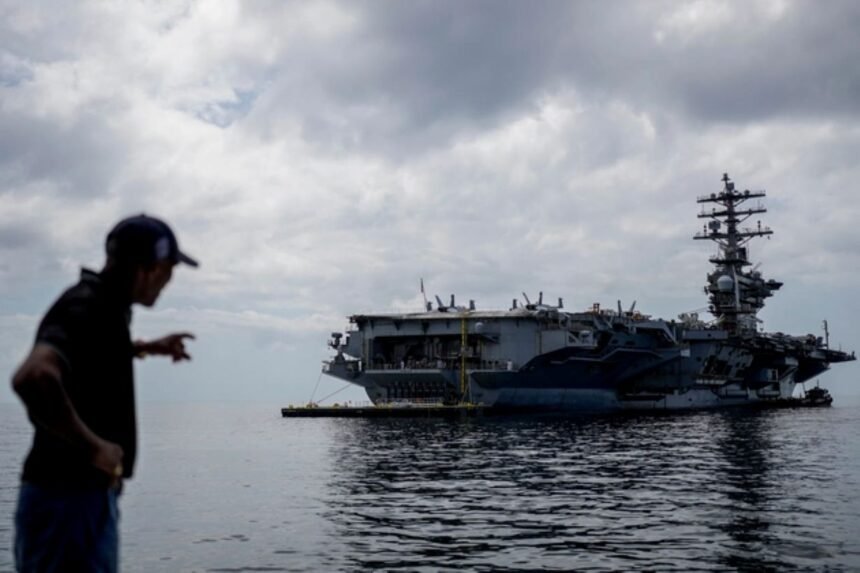
- The USS Nimitz Carrier Strike Group: Having entered the Caribbean in May, the nuclear-powered aircraft carrier is accompanied by an array of guided-missile cruisers and destroyers capable of executing heavy precision land-attacks.
- The Drone Blanket: Advanced American reconnaissance drones and specialized electronic warfare aircraft have been logging round-the-clock flight paths around Cuban airspace for months, according to public flight-tracking data.
- The Amphibious Reserves: The USS Kearsarge amphibious ready group—housing 2,500 combat-ready U.S. Marines—is currently positioned off the coast of Virginia executing pre-deployment drills, ready to relieve or reinforce forward ships.
[U.S. Southern Command Operational Matrix]
├── Strategic Aim     --> Decapitation strikes on Havana leadership / Target: Raúl Castro.
├── Current Assets    --> USS Nimitz Carrier Strike Group, tactical drone fleets, guided destroyers.
└── Logistics Strain  --> Overextended 10-month deployments competing with active Iran naval blockade.
The arrival of the USS Nimitz in regional waters directly coincided with the formal U.S. indictment of former Cuban President Raúl Castro, a synchronization experts view as deliberate psychological warfare.
“The Nimitz is likely there primarily for intimidation, though it could be used in a military operation if needed,” explained Mark Cancian, a senior analyst at the Center for Strategic and International Studies (CSIS). “Air strikes are possible to take out their air defenses to allow broader air operations or, perhaps, destroy their leadership… Raúl Castro would be their first target.”
Operational Vulnerabilities: Fleet Exhaustion and Retention Risks
Despite the ready-to-strike posture, defense planners are facing a ticking clock. The continuous cycle of rapid, back-to-back deployments is pushing the U.S. Navy’s surface fleet and personnel to their structural limits.
Many of the primary warships currently patrolling the Caribbean are approaching an unprecedented 10 consecutive months at sea—far exceeding the standard six-to-seven-month deployment window. This logistical strain is compounded by the fact that the Navy is concurrently managing a heavy operational blockade against Iranian shipping networks in the Arabian Gulf.
| Naval Vessel | Deployment Status | Critical Fleet Impact / Extension Notes |
| USS Nimitz | Extended past standard window. | Reaching the end of its 50-year career; nuclear decommissioning delayed until 2027 to sustain Caribbean operations. |
| USS Gerald R. Ford | Completed 11-month deployment. | Returned to port this month after back-to-back operations spanning Europe, the Caribbean, and the Middle East. |
| USS Iwo Jima & USS Fort Lauderdale | Returning to Norfolk next week. | Amphibious assault ships rotating out after extended summer deployments. |
The relentless operational tempo has raised serious alarm bells within the Pentagon regarding crew burnout and long-term fleet maintenance.
“Keeping them out there so long creates more problems in the long run when it comes to refitting and repairing those ships once they come home,” a defense official stated on the condition of anonymity.
Furthermore, military analysts warn that open-ended extensions directly threaten military retention rates, as families buckle under the strain of unpredictable schedules. The White House has referred all formal inquiries regarding the regional buildup to the Pentagon, while the Navy has declined to comment on current or future ship deployments.