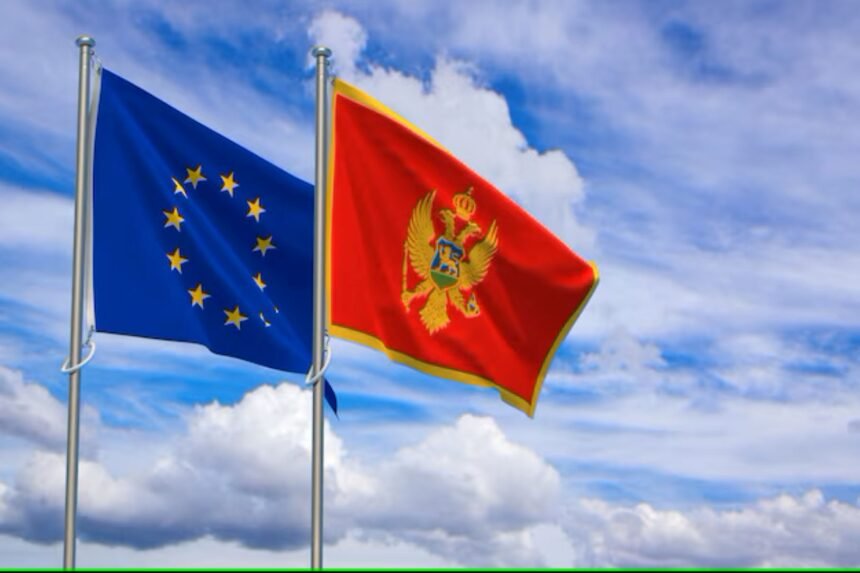
The European Union is quietly laying the institutional groundwork for its first enlargement wave in over a decade, with Montenegro uniquely positioned as the only candidate nation with a realistic short-term horizon for full integration.
Speaking at an EU Foreign Ministers meeting in Brussels, EU Enlargement Commissioner Marta Kos signaled that the bloc must shift from geopolitical rhetoric to tangible actions. Reinforcing this mandate, Kos revealed that for the first time in 17 years, the European Commission has established an official working group dedicated exclusively to drafting the formal accession treaty for a candidate state: Montenegro.
“There is no clearer signal that the EU views Montenegro as its next member,” Strahinja Subotić, a program manager and researcher at the European Policy Centre (CEP) in Belgrade, told DW.
The Shift from Technical Benchmarks to Geopolitical Necessity
Russia’s 2022 invasion of Ukraine fundamentally revitalized the EU’s stagnant enlargement policy, re-framing expansion from a rigid, technocratic auditing process into an urgent geopolitical and security priority.
However, experts note this geopolitical urgency is meeting strong internal friction from member states demanding internal EU governance overhauls before admitting new members.
“The geopolitical necessity for enlargement is recognized by all member states,” Steven Blockmans of the Centre for European Policy Studies (CEPS) told DW. “But it is always accompanied by two things: a merit-based approach with no shortcuts, and the necessity for the European Union itself to reform its own policies and methods of governance.”
Rethinking a 40-Year-Old Accession Model
With the existing enlargement framework relying on methodologies developed nearly four decades ago, intense debates are brewing in Brussels regarding “gradual” or “phased” integration models.
The focus is pivoting toward granting candidate states early access to specific EU structures in exchange for meeting incremental reform milestones.
[Proposed Phased Integration Framework]
├── Pre-Accession Phase --> Early access to the Single Market & Observer status in EU bodies.
├── Full Membership     --> Formal entry with robust post-accession monitoring frameworks.
└── Temporary Safeguards --> Potential time-bound restrictions on voting / veto rights.
Recently, German Chancellor Friedrich Merz floated a radical proposal calling for the immediate opening of all negotiation chapters with Ukraine, suggesting an “associated membership” status. Under this model, Kyiv, Moldova, and Western Balkan states would gain privileged access to the EU Single Market, observer status in EU decision-making bodies, and alignment on foreign and security policy prior to full ratification.
Conversely, the highly controversial concept of “reverse enlargement”—championed by Ukrainian President Volodymyr Zelenskyy, which envisioned formal entry into the bloc first with institutional reforms finalized post-facto—was flatly rejected by member states.
Breaking the Veto Taboo: “Not a Second-Class Membership”
The most sensitive institutional debate centers on how future accessions will impact the EU’s voting structures, particularly in policy areas that require absolute unanimity. To prevent institutional paralysis, EU planners are seriously debating temporary, time-bound restrictions on the right to veto for newly admitted states.
| Strategic Dimension | Structural Mechanism | Candidate Country Sentiment |
| Gradual Veto Curbs | Time-bound restrictions confined to specific policy fields, embedded directly into accession treaties. | Albania, Bosnia & Herzegovina, and Serbia have signaled openness to temporary curbs to accelerate entry. |
| Post-Accession Safeguards | Enhanced monitoring tools with clear penalty clauses for democratic backsliding. | Montenegro expects rigorous rule-of-law clauses but rejects transitional or partial membership status. |
Analysts emphasize that these mechanisms are not designed to create a “second-class membership,” but rather to reassure skeptical, long-standing member states that an expanded union of 30+ nations can remain functional.
Montenegro as the EU’s “Guinea Pig”
While countries like Albania and Serbia have hinted at accepting temporary veto restrictions to speed up their timelines, Podgorica is firmly pushing for full, uncompromised integration under the bloc’s current operational rules.
Consequently, regional experts believe Montenegro will serve as the ultimate testing ground for the EU’s revamped enlargement mechanisms. The accession treaty currently being drafted in Brussels is highly anticipated to feature the most stringent post-accession monitoring tools and rule-of-law safeguard clauses in EU history, serving as a legal blueprint for all future candidate nations.
“One can expect Montenegro to become a ‘guinea pig’ to test the limits of transitional arrangements and safeguard clauses,” Blockmans concluded, noting that Podgorica’s path will define the parameters of the European project for the next generation.