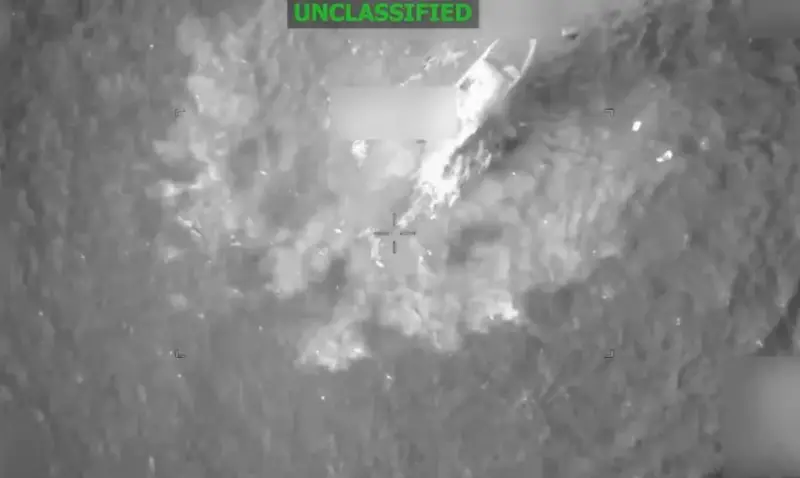
United States military forces have executed another lethal kinetic strike against a suspected narcotics vessel in the Eastern Pacific Ocean, resulting in two fatalities.
The operation marks the second consecutive day of lethal maritime strikes in the region by the U.S. military. Just 24 hours prior, a similar strike on a suspected smuggling vessel in the Eastern Pacific left one man dead and two survivors. In that instance, U.S. Southern Command (SOUTHCOM) stated it “immediately notified the U.S. Coast Guard to activate the Search and Rescue system for the survivors.”
For the latest engagement, SOUTHCOM released operational footage on social media documenting the targeted boat idling in open waters moments before being struck by an explosion, with the final seconds of the video showing heavy smoke and fire rising from the vessel.
The Aggressive Mandate of the “Drug War”
The current strikes are part of an aggressive, highly controversial campaign authorized by the Trump administration to intercept and destroy suspected drug-trafficking vessels in Latin American transit zones, stretching across the Eastern Pacific and the Caribbean Sea.
[SOUTHCOM Counter-Narcotics Campaign Timeline]
  September (Inception) ───► Total Interdictions ───► At Least 196 Fatalities Reported
Since the operation’s inception in early September, at least 196 people have been killed during these high-seas engagements. To date, the military has not publicly provided physical evidence or cargo manifests proving that any of the targeted vessels were carrying narcotics at the time they were destroyed.
The Trump administration has robustly defended the kinetic approach, asserting that the United States is in an active state of war against Latin American drug cartels. The White House maintains that these transnational criminal organizations are directly responsible for the historic wave of fatal drug overdoses devastating American communities.
Pentagon Inspector General Opens Probe Into Targeting Protocol
As casualties mount, the Pentagon’s independent watchdog announced it is stepping in to investigate the internal mechanics of the operation. The Office of the Inspector General (OIG) announced a self-initiated evaluation to assess whether U.S. forces are strictly adhering to established military frameworks during these operations.
Specifically, the OIG review will determine if personnel are properly executing the military’s standardized Six-Phase Joint Targeting Cycle, a structured doctrine designed to ensure precision, accountability, and clear lines of authority during kinetic actions:
[The Six-Phase Joint Targeting Cycle]
  1. Commander's Intent ──► 2. Target Development ──► 3. Capability Analysis
                                                                  │
  6. Combat Assessment  ◄──  5. Mission Execution ◄──  4. Commander's Decision
The Inspector General’s office explicitly noted that the review is “self-initiated” and will focus strictly on operational compliance rather than the overarching international legality of the strikes.
The legal justification for deploying military-grade kinetic force against civil criminal suspects in international waters has drawn heavy scrutiny from military law scholars and several congressional Democrats, who have questioned the domestic and international statutory authority underwriting the lethal campaign.