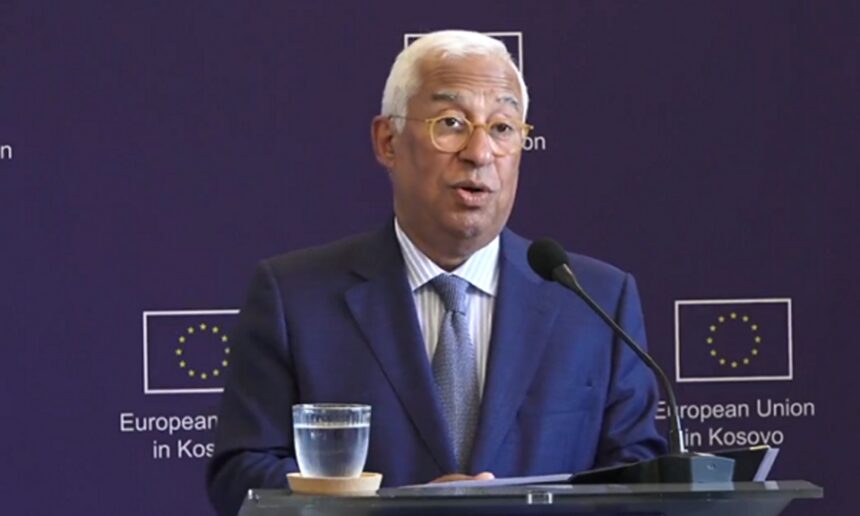
PRISTINA – President of the European Council Antonio Costa called on Kosovo and Serbia to focus on the future rather than past conflicts, stressing that reconciliation and regional cooperation are essential for European integration.
During his visit to Kosovo on Tuesday, Costa met with the country’s political leaders and later addressed the media. He was asked about the continuation of the EU-facilitated dialogue between Kosovo and Serbia, as well as accountability for Serbia regarding the September 2023 terrorist attack in Banjska.
Responding to the questions, Costa pointed to the origins of the European Union, citing the post-World War II reconciliation between Germany and France as an example of how former adversaries can build a common future.
“The European Union is a peace project,” Costa said. “It was born from the ashes of the Second World War when former enemies, particularly Germany and France, decided to overcome their dramatic history and focus on a shared and prosperous future.”
He added that many European countries have experienced serious disputes with their neighbors in the past, but emphasized that lasting progress requires prioritizing the future over historical conflicts.
“We all have had problems with our neighbors. Sometimes very, very serious ones. But we must decide what we value more: our common future or the conflicts we have had with one another in the past. We need to focus on the future,” Costa stated.
According to him, the same message is being delivered both in Pristina and Belgrade. He stressed that meaningful progress in the dialogue requires commitment and good faith from both sides.
“If it is important for the European Union to engage in this dialogue, it is equally essential for Belgrade to engage in it as well. Everyone must act in good faith and recognize what needs to be recognized while keeping the focus on the future,” he said.
Costa was also questioned about Kosovo’s application for membership in the European Union and why its application dossier has not yet been addressed by the bloc.
Asked whether the delay was caused by political instability in Kosovo or the lack of unanimity among EU member states, Costa responded that every issue has its time and that Kosovo must continue fulfilling its commitments under the accession process.
“We have agreed on the reform agenda, and we have agreed on the accession process to the European Union. It is very important that Kosovo fulfills, step by step, the commitments that have already been agreed upon,” Costa said.
He expressed confidence that the EU would not pose obstacles once Kosovo completes the necessary reforms and obligations.
“I am convinced that at the end of this process we will have no problem on the side of the European Union. What is needed now is for the broad national consensus in favor of European integration to be translated into concrete actions and for Kosovo to remain on a clear path toward achieving this goal,” Costa concluded.