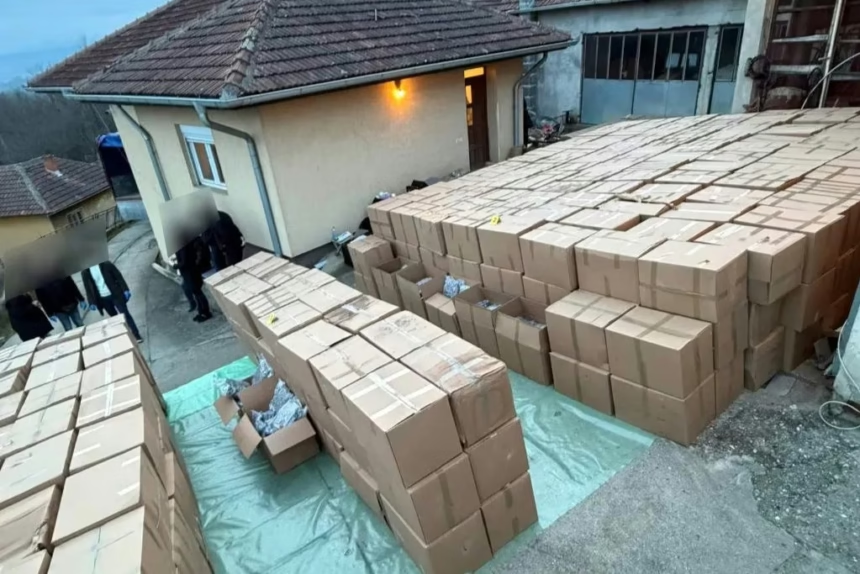
Serbia’s Prosecutor’s Office for Organized Crime (TOK) has filed an indictment against six individuals in connection with the seizure of nearly five tonnes of cannabis in the village of Konjuh, a case that has drawn significant public attention and fueled questions about possible political connections.
According to the indictment, Aleksandar Mijajlović is accused of organizing the criminal group, while Ivan Dragnić is identified as a co-organizer. Nebojša Spasojević, Rade Spasojević, Uroš Mladenovski and Robert Živković have been charged as members of the alleged organized criminal group. The defendants face charges of the unauthorized production and trafficking of narcotic drugs.
Despite the indictment, legal experts and journalists covering the case argue that key questions remain unanswered.
Attorney Jovan Rajić said the prosecution’s announcement does not address alleged financial transactions, potential links to senior state officials, or how the large quantity of cannabis was allegedly transported across the border from North Macedonia into Serbia.
“It seems to me that this was practically a public statement saying, ‘You asked for an indictment, here it is. These six people will be prosecuted, and don’t ask us for anything more,'” Rajić told N1.
Journalist Ivan Milićević, who has closely followed the investigation, said the indictment differs from the original criminal complaint and questioned how such a large shipment of cannabis could have entered Serbia and been stored near Kruševac without attracting the attention of authorities.
He also referred to previously published witness statements alleging that, during the arrests, SNS municipal councilor Rade Spasojević claimed the seized drugs were “state-owned” and suggested contacting former minister Bratislav “Bata” Gašić. Milićević noted that investigators have not publicly pursued that line of inquiry or clarified the allegations.
At the same time, he acknowledged that prosecutors may have rushed to file the indictment in order to maintain the suspects’ detention while leaving open the possibility of separate financial investigations. However, he expressed skepticism that the investigation would ultimately establish any political responsibility.
Rajić argued that important aspects of the case may have been excluded from the investigation from the outset, pointing to the removal of the original prosecutor handling the case as a signal that the investigation’s scope had been limited.
Responding to questions from N1, the Prosecutor’s Office for Organized Crime said the current indictment does not rule out future investigations into border crossings, financial transactions, or the potential responsibility of additional individuals.
“If there are grounds to examine other facts or the responsibility of other persons, this will be the subject of proceedings by the competent state authorities within their legal powers,” the prosecution said, adding that it could not disclose further details in order to avoid compromising the ongoing proceedings.
The court will now decide whether to confirm the indictment, return it for further investigation, or dismiss it. Meanwhile, authorities in North Macedonia are continuing their part of the investigation.