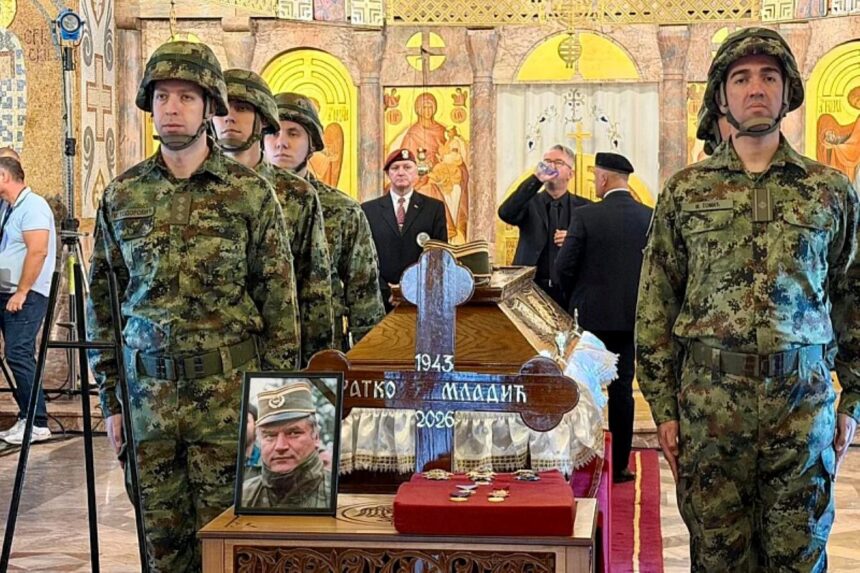
The funeral of former Bosnian Serb military commander Ratko Mladić has once again exposed the deep divide over Serbia’s wartime past, as state institutions, political figures and sections of society have honored a man who was convicted of genocide, crimes against humanity and war crimes.
Mladić is due to be buried Monday at Topčider Cemetery in Belgrade after his body was displayed at the Church of St. Luke, where a funeral service was held. A memorial ceremony had already taken place at the Serbian Army House, a state institution, organized by retired military officers.
The ceremony was attended by members of Mladić’s family, former members of the Army of Republika Srpska, politicians and officials from Belgrade and Banja Luka, including Republika Srpska President Siniša Karan and Serbian Justice Minister Nenad Vujić. Serbian media reported that some outlets, including N1, were not accredited to cover the event.
Although Serbia did not formally declare a state funeral, critics argue that the state provided many of the elements normally associated with an official ceremony. Mladić’s body was transported on a Serbian government aircraft, the coffin was covered with a flag, state and military representatives participated in the reception, and the memorial was held inside a Serbian Ministry of Defense facility.
That has blurred the distinction between a private funeral and state recognition, allowing the authorities to appeal to nationalist sentiment at home while maintaining that the funeral itself was not officially organized as a state event.
Vučić’s familiar balancing act
President Aleksandar Vučić has maintained a careful distance from the funeral itself. He is not expected to attend, citing previously scheduled state obligations, and did not attend the memorial ceremony.
At the same time, Vučić has publicly said he did everything possible to ensure that Mladić’s final farewell would take place “with dignity.”
He has previously criticized the Hague tribunal for not allowing Mladić to spend his final days in Serbia, describing its treatment of him as “anti-civilizational.” Vučić also dismissed European Enlargement Commissioner Marta Kos’s decision to cancel a planned visit to Serbia over the glorification of Mladić as “stupid.”
The approach reflects a familiar political balancing act: maintaining distance from actions that could further damage relations with the European Union while avoiding a direct confrontation with the nationalist electorate that continues to regard Mladić as a hero.
But in the case of Mladić, critics argue, there is little room for political ambiguity. The international courts have issued final judgments establishing his responsibility for some of the worst crimes committed during the Bosnian war.
Mladić’s image returns to the stadium
The glorification of Mladić has also appeared outside official ceremonies.
During a recent Red Star Belgrade match against Partizan, supporters displayed a large banner featuring Mladić alongside the message “Direction Potočari,” an apparent reference to words attributed to him after Bosnian Serb forces entered Srebrenica in July 1995.
Another banner referenced Reuf Selmanagić Crni, whose name had been associated with a street in Srebrenica before the sign was reportedly removed on Mladić’s orders in 1995.
Potočari is not simply a geographic reference. It was the site where thousands of Bosniak civilians sought protection in July 1995 before men and boys were separated from their families and systematically killed in the genocide.
Mladić was ultimately convicted of genocide in Srebrenica, as well as persecution, extermination, murder, deportation, terrorizing civilians during the siege of Sarajevo and taking UN peacekeepers hostage.
For critics, the use of Potočari as a celebratory reference therefore goes beyond honoring a former military commander. It invokes the very campaign of violence for which Mladić was convicted.
Europe’s warnings and Serbia’s calculations
The European Union has responded with condemnation but limited immediate leverage.
Marta Kos canceled her planned visit to Serbia, saying that glorifying a person convicted of genocide and war crimes is incompatible with the values underpinning Serbia’s path toward EU membership. Other European officials have also condemned the treatment of Mladić.
The episode has nevertheless revived a broader debate over the effectiveness of the EU’s approach toward Serbia.
Serbia received EU candidate status in 2012 and formally opened accession negotiations in 2014. More than a decade later, the process remains stalled, while Belgrade continues to balance its relations with Brussels, Moscow and Beijing.
Critics argue that repeated European warnings have too rarely been accompanied by clear political consequences, allowing Serbian authorities to maintain cooperation with the EU while continuing to tolerate or participate in the glorification of convicted war criminals.
The result, they argue, is a form of strategic ambiguity in which regional stability and geopolitical considerations repeatedly take precedence over accountability and reconciliation.
A test of Serbia’s relationship with its past
Mladić’s death has not created a new historical question about his role in the Bosnian war. His responsibility has been established through final international judgments.
The more difficult question is what Serbia chooses to do with that legacy.
The funeral, the state-linked memorial ceremony and public displays of Mladić’s image suggest that his legacy remains deeply contested and politically useful.
Serbia’s challenge is therefore not simply whether it recognizes a court verdict. It is whether its political institutions and society are prepared to distinguish remembrance from glorification, acknowledge victims and confront the ideology that enabled some of the worst crimes of the 1990s.
Mladić will be buried, but the political struggle over his legacy is unlikely to end with his funeral.