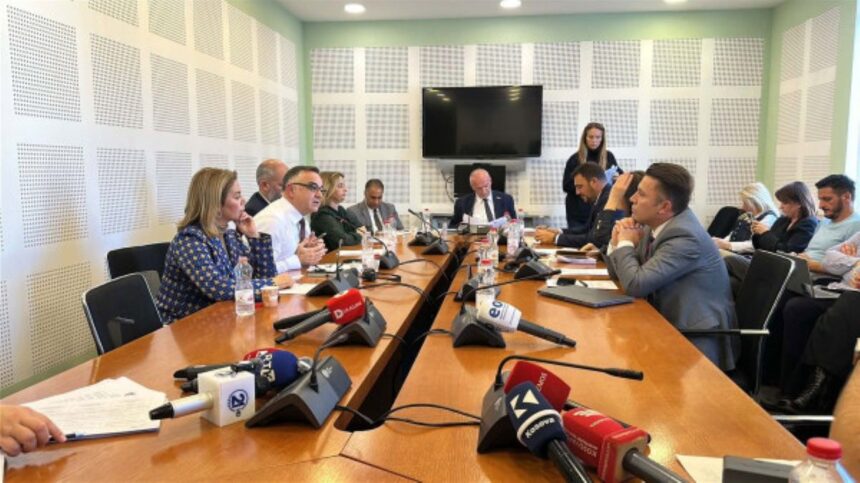
Kosovo’s parliamentary Committee on Legislation, Mandates, Immunities, the Rules of Procedure and Oversight of the Agency for the Prevention of Corruption is reviewing the draft law on the State Bureau for the Verification and Confiscation of Unjustified Assets, with lawmakers divided over several key provisions.
During the review, Democratic League of Kosovo (LDK) MP Doarsa Kica-Xhelili raised concerns about the procedure for appointing the bureau’s director, the qualifications required of judges handling appeals, the professional experience required of bureau members and the financial threshold for initiating asset verification.
Kica-Xhelili criticized the proposal to elect the bureau’s director by a simple majority of MPs participating in the vote. She said that if 61 MPs were present, just 31 votes would be sufficient to elect the director.
She also questioned why specialized judges would be required at the first-instance level but not at the appellate level, which would review the legality of first-instance decisions.
Another point of disagreement concerns the professional experience required of bureau members. Kica-Xhelili said lawmakers had discussed setting the minimum requirement at seven years, but she had subsequently been informed that the Ministry might seek to reduce it to five years.
She described such a reduction as unacceptable, arguing that members of an institution responsible for examining potentially unjustified wealth should have substantial professional experience.
Kica-Xhelili also raised concerns about the proposed threshold for initiating asset verification, which remains set at €25,000. She argued that the threshold should be reconsidered, particularly because the bureau would examine assets accumulated over a period extending back to 2008.
Committee chair defends the review process
Committee chair Vigan Qorrolli said lawmakers had carefully considered comments and proposals submitted by MPs, the Supreme Court and civil society representatives.
He said the working group had examined the proposed amendments in detail and that no comments or recommendations had been ignored. According to Qorrolli, some amendments submitted by MPs and civil society had been accepted as part of the review process.
Addressing concerns about the relationship between civil and criminal asset confiscation proceedings, Qorrolli said information used in civil confiscation proceedings could not be used as evidence in criminal proceedings.
He added that competent authorities could nevertheless initiate separate investigations on their own initiative, in accordance with the law. Qorrolli cited the Venice Commission’s assessment in defending the proposed distinction between civil and criminal procedures.
Opposition MP warns against potential persecution
Alliance for the Future of Kosovo (AAK) MP Besnik Tahiri questioned whether the bureau should be able to examine the assets and activities of former senior public officials after they leave office.
Tahiri argued that former officials should be treated as private individuals once their public mandates end. He warned that continued scrutiny of their financial activities could risk becoming a form of persecution rather than a legitimate investigation.
He questioned the circumstances under which former officials could be investigated for their activities after leaving public office, arguing that they should be free to pursue private employment and other lawful activities.
Vetëvendosje says the bill has undergone extensive scrutiny
Adnan Rrustemi, an MP from the ruling Vetëvendosje Movement, defended the draft legislation, describing it as one of the most extensively reviewed bills since Kosovo declared independence.
Rrustemi said the bill had been examined across several parliamentary legislatures, voted on in two readings, reviewed by the Constitutional Court and considered multiple times by the Venice Commission.
He argued that the current draft did not differ substantially from earlier versions that had already received parliamentary support, including versions previously backed by members of the LDK.
The proposed law aims to establish a mechanism for verifying and confiscating assets deemed unjustified. However, disagreements over appointment procedures, judicial specialization, qualification requirements and safeguards for former public officials remain central to the parliamentary debate.