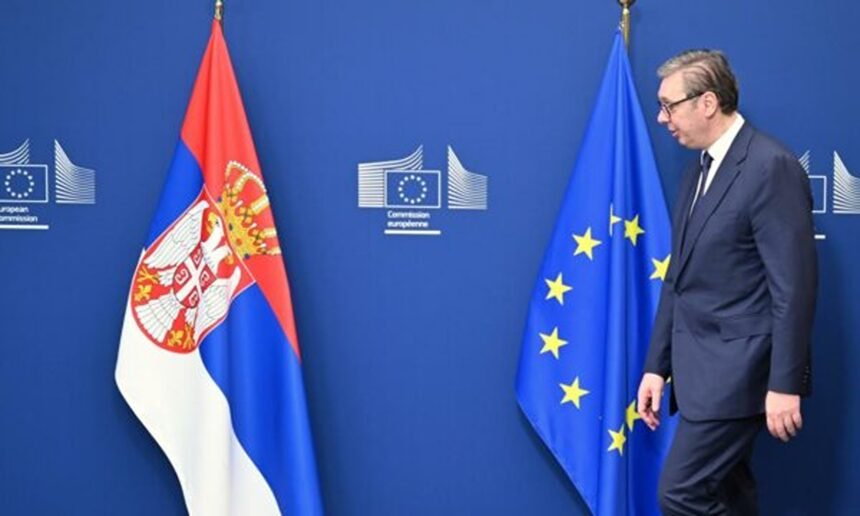
The European Union has expressed growing concern over Serbia’s practice of granting citizenship to Russian nationals, warning that the policy could create security risks for EU member states by allowing new Serbian citizens to travel visa-free throughout much of Europe.
According to EU officials, the issue has become a significant point of concern because Serbian citizenship provides access to the EU’s visa-free travel regime. Brussels fears that among those obtaining Serbian passports through accelerated procedures could be individuals who pose security threats or are subject to international sanctions.
The European Union has repeatedly called on Serbia to discontinue the practice and to further align its visa and migration policies with those of the EU.
On Thursday, the European Commission reiterated its concerns, recalling that the issue had already been highlighted in previous progress reports on Serbia’s EU accession process.
Guillaume Mercier, the European Commission’s spokesperson for enlargement, stated that the matter remains under close scrutiny by Brussels.
“Already in last year’s report, it was noted that, in particular, the possibility for Russian nationals to benefit from visa-free travel to the EU through the acquisition of Serbian citizenship presents potential security risks for the European Union,” Mercier said.
Media reports have suggested that some Russian citizens receiving Serbian nationality through expedited procedures may include individuals considered high-risk or persons listed under European Union sanctions.
EU officials confirmed that discussions with Serbia on the issue are ongoing and expressed hope that a solution could be reached in the near future.
The controversy comes amid broader criticism from Brussels regarding Serbia’s relationship with Russia. Belgrade continues to face pressure from the EU for refusing to align fully with European sanctions imposed on Moscow following Russia’s actions in Ukraine.
The EU has also criticized Serbia for the slow pace of aligning its visa regime with European standards. In previous years, Serbia granted visa-free access to citizens of several countries, including Iran and Burundi, a move that drew concern from European institutions over migration and security implications.
Brussels has issued similar calls to all Western Balkan countries, urging them to harmonize their visa policies with those of the European Union. The objective is to prevent the region from being used as a transit route for irregular migration into EU member states.
European officials have warned that countries failing to align their visa policies with EU standards could ultimately jeopardize their own visa-free travel arrangements with the bloc.
The issue is expected to remain a significant topic in Serbia’s accession negotiations, as the EU continues to emphasize security cooperation, migration management, and foreign policy alignment as key requirements for membership.