Serbia’s National Assembly continued its debate on a no-confidence motion against the government on Wednesday, with sharp exchanges over the role of the country’s Security Intelligence Agency (BIA) and controversial remarks made by Public Administration and Local Self-Government Minister Snežana Paunović.
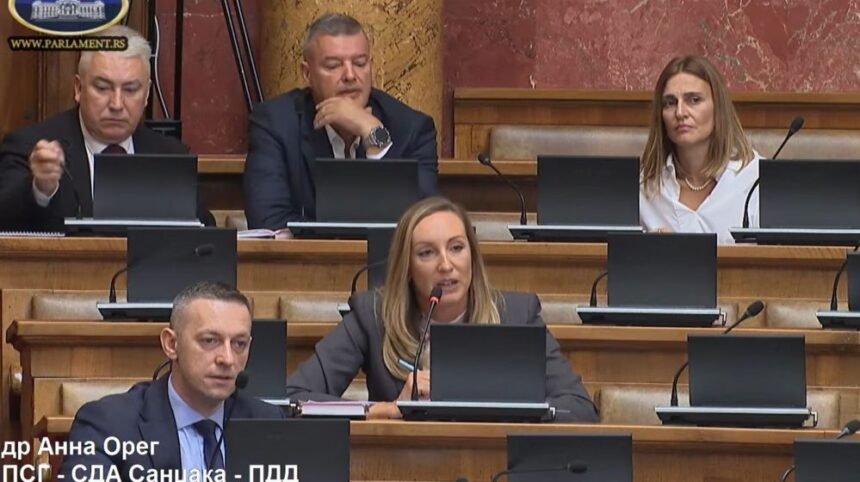
Anna Oreg, an MP representing the PSG–SDA–PDD parliamentary group, argued that the debate extended beyond the government’s survival and reflected a broader crisis of confidence in Serbia’s institutions.
“We are not only discussing confidence in the government, but confidence in the entire system, where functions are ornamental, institutions are decorative, and accountability is an unknown concept,” Oreg told parliament.
She said Prime Minister Đuro Macut’s cabinet lacked genuine authority, arguing that key decisions were made elsewhere. Oreg also criticized the circumstances surrounding the formation of the current government, recalling that former Prime Minister and Serbian Progressive Party (SNS) leader Miloš Vučević resigned after members of the ruling party were accused of assaulting a female student activist.
According to Oreg, early elections should have been called at that time rather than forming a new government.
The opposition lawmaker also strongly condemned recent comments by Minister Snežana Paunović, who said that, had former Serbian President Slobodan Milošević been in charge in 1998, he “would have carried out ethnic cleansing in Kosovo.” Oreg described the statement as unacceptable and reiterated her party’s zero-tolerance stance toward ethnic hatred.
She said the PSG had consistently honored victims from all sides of the conflicts in the former Yugoslavia, noting that party representatives had attended commemorative events in both Srebrenica and Donji Žitkovac.
Oreg criticized members of the government, including ministers from minority communities, for failing to publicly distance themselves from Paunović’s remarks. She also accused the cabinet of serving merely as symbolic figures without real influence over state policy.
Addressing another issue, Oreg questioned the legality of surveillance conducted by Serbia’s Security Intelligence Agency (BIA), claiming there was no legal basis for monitoring her communications. The surveillance reportedly forms part of evidence in proceedings involving a group of Novi Sad activists.
Responding on behalf of the ruling SNS, MP Milenko Jovanov defended the intelligence agency’s actions, arguing that they demonstrated the BIA had acted lawfully to protect Serbia’s constitutional order.
“The BIA was doing its job by preventing attempts to destabilize the country and avoiding civil conflict,” Jovanov said.
He further alleged that foreign actors had sought to influence political developments in Serbia, adding that the intelligence agency’s work had been effective enough that even the leader of the opposition party had distanced himself from some of the activists under investigation.
The parliamentary debate on the no-confidence motion is expected to continue as lawmakers remain divided over the government’s performance and broader questions regarding the rule of law, institutional independence, and political accountability.