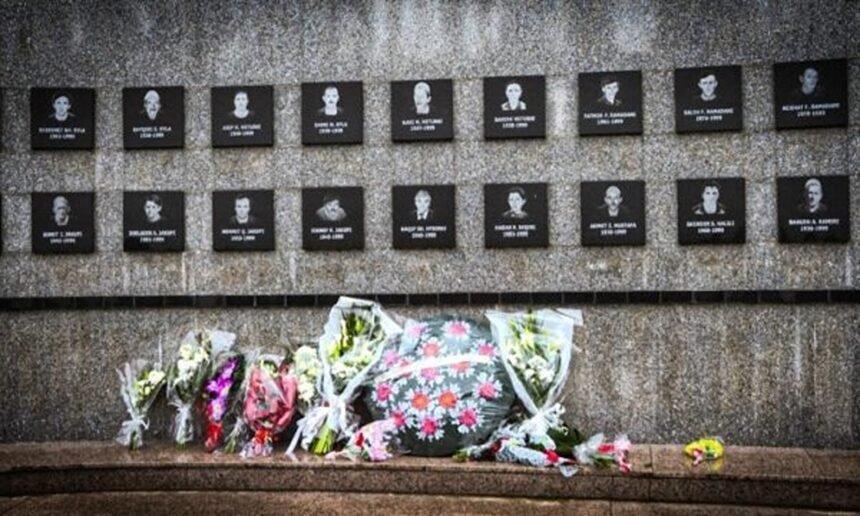
The Special Prosecution Office of the Republic of Kosovo (SPRK) has detailed serious allegations against five recently arrested Serbian suspects accused of participating in the Recak Massacre, one of the most infamous atrocities committed during the Kosovo War.
The suspects: Novica Pećinoqević, Stanoje Janićević, Borko Palić, Slađan Milisavljević, and Stanko Savić have been ordered into one month of pretrial detention by the Basic Court of Prishtina.
According to prosecution documents, the five men are suspected of committing war crimes against Kosovo Albanian civilians, including murder, torture, inhumane treatment, destruction of property, forced displacement, and ethnic cleansing.
Serbian Police Units Allegedly Led Deadly Operation
According to the prosecution, on 15 January 1999, Serbian police and special police units launched a coordinated military-police operation against the village of Recak in the municipality of Shtime.
Investigators allege that Serbian forces surrounded the village at approximately 6:00 a.m. from several strategic positions before bombarding the area with heavy weapons. Armored vehicles then entered the village and Serbian units began conducting house-to-house operations.
Four of the suspects were allegedly members of Serbia’s Special Police Units (PJP), while the fifth served as a police officer in Ferizaj during the war.
Prosecutors: 42 Albanian Civilians Were Killed
The prosecution alleges that Serbian forces participated in the killing of 42 Kosovo Albanian civilians, none of whom were involved in combat.
According to the case file, Serbian forces carried out executions across multiple locations in the village.
Among the allegations is the claim that one civilian was murdered and subsequently beheaded. Other victims were reportedly executed in courtyards, fields, and village roads as Serbian forces advanced through Recak.
Investigators further allege that civilians attempting to escape toward the surrounding hills were ambushed by Serbian police officers, who opened fire without warning, killing several people and injuring others.
Mass Execution at Bebush Hill
One of the most chilling allegations concerns a group of villagers who had sought refuge at the home of Sadik Osmani.
According to prosecutors, Serbian forces separated men from women and children, locking women and children in a basement while approximately 30 male civilians were detained outside.
The men were allegedly beaten with rifle butts, chains, wooden sticks, kicks, and other objects before being forced into a column and marched toward an area known as Bebush Hill.
There, prosecutors allege, Serbian forces opened fire from both sides of the road, carrying out a mass execution that killed 24 civilians.
Torture and Inhumane Treatment
The prosecution also accuses the suspects of participating in the systematic torture and inhumane treatment of Albanian civilians.
Witness testimony and evidence gathered by investigators describe detainees being forced to lie on the ground while Serbian police officers beat them repeatedly under armed supervision.
According to the prosecution, these actions constituted grave violations of international humanitarian law and the Geneva Conventions.
Homes Burned and Civilian Property Destroyed
Beyond the killings, prosecutors allege that Serbian police and military forces deliberately destroyed civilian property throughout Recak.
The case file states that after residents were forced from their homes, Serbian forces set houses on fire and destroyed personal belongings and property, causing extensive material damage to the Albanian population.
Investigators argue that the destruction formed part of a broader campaign directed against civilians.
Around 20,000 Albanians Expelled
The prosecution further alleges that Serbian forces carried out the mass expulsion of civilians from Recak and surrounding villages, including Topillë, Petrovë, Kraishtë, Mullapolc, and Dremjak.
According to investigators, approximately 20,000 Kosovo Albanian civilians were forced from their homes.
Women and children were allegedly driven out of the area, while many detained men were subsequently executed.
Prosecutors describe the operation as a coordinated campaign of forced displacement and ethnic cleansing targeting the Albanian population of the region.
Facing War Crimes and Crimes Against Humanity Charges
Kosovo’s Special Prosecution Office says there is a well-founded suspicion that the five suspects jointly committed war crimes against the civilian population, crimes that today correspond to crimes against humanity under Kosovo’s Criminal Code.
The case is reportedly supported by witness testimony, video evidence, operational records, victim identifications, and other investigative materials collected during years of investigation.
The arrests mark another significant step in Kosovo’s efforts to pursue accountability for crimes committed during the 1998–1999 war. The Recak Massacre remains one of the most significant documented atrocities of the conflict and played a pivotal role in drawing international attention to the violence carried out against Kosovo Albanian civilians.