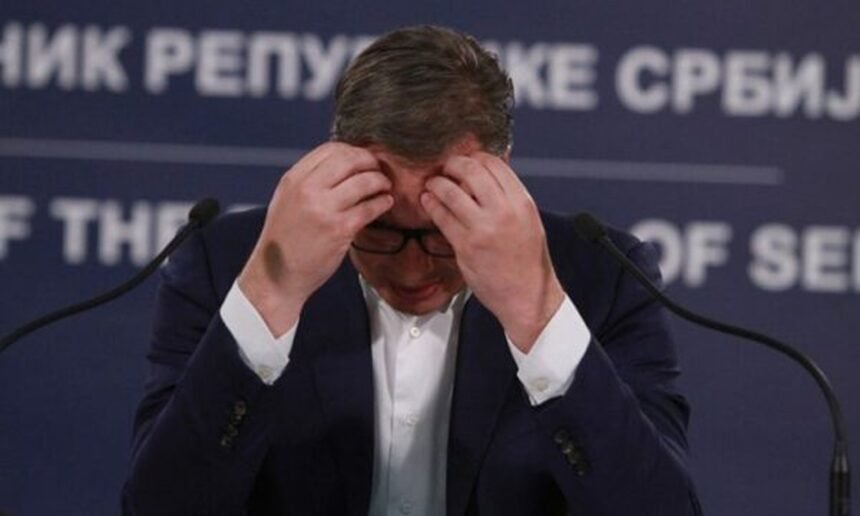
Serbian foreign policy analyst Boško Jakšić has accused Serbian President Aleksandar Vučić of systematically pursuing what he described as a project aimed at the political “de-recognition” of Montenegro’s independence, drawing parallels with Serbia’s long-running campaign against the international recognition of Kosovo.
Speaking on Montenegro’s TV E program 24 sata, Jakšić dismissed Vučić’s recent allegations that Montenegro is waging a “hybrid war” against Serbia, arguing instead that Belgrade has never fully accepted Montenegro’s independent political path.
According to Jakšić, Vučić has struggled to accept key sovereign decisions made by Montenegro, including its recognition of Kosovo and its accession to NATO.
“He does not understand that Montenegro recognized Kosovo and joined NATO because it considered those decisions to be in its own national interest. Today Montenegro is only one step away from European Union membership, while Serbia has fallen to the back of a line it once led,” Jakšić said.
The Serbian analyst argued that relations between Belgrade and Podgorica have been shaped by long-standing tensions dating back to the era of Milo Đukanović, followed by what he described as years of efforts to deepen identity divisions within Montenegro and increase Serbian political influence in the country.
Jakšić stressed that Serbia has the right to care about the Serbian community in Montenegro, but said such engagement should follow European democratic standards rather than what he characterized as destabilizing political activities.
He further alleged that Vučić has used the Serbian Orthodox Church and political allies in Podgorica as instruments of influence in Montenegro’s domestic affairs.
Commenting on Serbian Interior Minister Ivica Dačić, Jakšić claimed that Dačić has increasingly aligned himself with Vučić’s political agenda and has become one of the most vocal promoters of the concept commonly referred to as the “Serbian World.”
Tivat Incident Reflects Broader Tensions
Jakšić also commented on the recent case involving 87 Serbian citizens who were denied entry into Montenegro and returned from Tivat Airport.
He described the incident as a failed political operation that, in his view, exposed broader objectives pursued by Belgrade in Montenegro.
“Vučić has not abandoned confrontation or efforts to destabilize Montenegro. For him, Montenegro is a testing ground for ambitions that Serbia should have access to the sea. He is a political student of Vojislav Šešelj and continues to believe in the concept of the ‘Serbian World’,” Jakšić stated.
According to the analyst, both Serbs in Montenegro and Serbs in northern Kosovo are frequently used as political instruments in support of domestic political objectives in Belgrade.
EU Integration at the Center of the Dispute
Jakšić argued that one of the primary goals of Vučić’s regional strategy is to slow Montenegro’s path toward membership in the European Union.
He noted that Montenegro is currently regarded as the most advanced EU candidate in the Western Balkans and could potentially become the bloc’s next member state by 2028.
“Montenegro is the leader of European integration in the region. That is precisely why Vučić is systematically working on what I call the project of de-recognizing Montenegro’s independence, following a model that was previously used against Kosovo. There is no reason to expect him to abandon that campaign,” Jakšić concluded.
The remarks come amid growing diplomatic tensions between Serbia and Montenegro, as both countries exchange accusations over political interference, regional influence, and competing visions for the future of the Western Balkans.