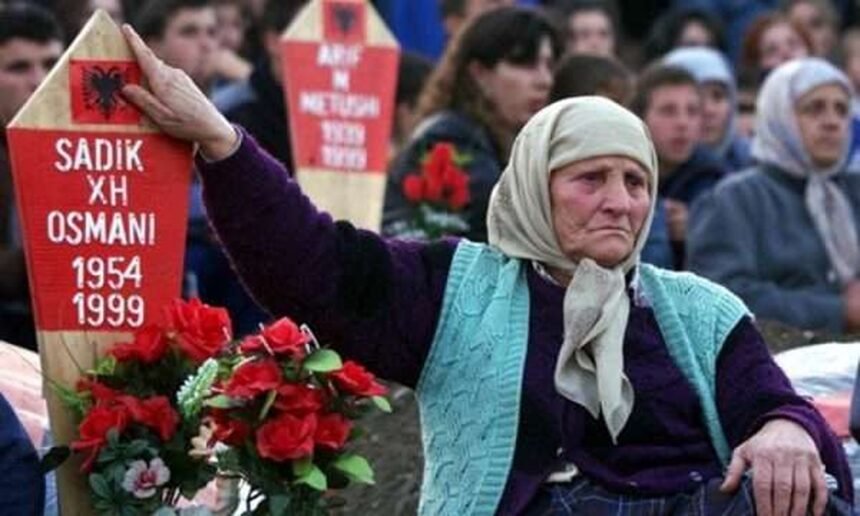
RECAK, Kosovo – More than 27 years after one of the most notorious atrocities of the Kosovo War, a survivor of the Recak Massacre has spoken publicly about the horrors he witnessed, following the arrest of five Serbian suspects accused of participating in the killing of Albanian civilians in January 1999.
Ramë Shabani, one of the last surviving eyewitnesses of the massacre, described scenes of unimaginable brutality as he recalled the day Serbian police and military forces attacked the village of Recak.
“Banush was without a head. Skender’s skull was shattered. Ajet, Rizah and his two sons, Shyq and his sons, Fatmir and his brothers, Jashar and his family. It was pure horror,” Shabani said, remembering the victims he found after the attack.
Shabani survived the massacre, which claimed the lives of 45 Kosovo Albanian civilians and became one of the defining symbols of Serbian atrocities during the war in Kosovo. The killings shocked the international community and played a crucial role in prompting international intervention against the regime of Serbian leader Slobodan Milošević.
“We Gathered the Bodies and Buried Them”
The survivor recalled how villagers worked through the night to collect and prepare the victims for burial.
“On the evening of January 16, we gathered the bodies and brought them to the mosque. People from Petrova and Mollopolc helped us. We prepared them as best we could for burial because there were so many. On January 17, Danica Marković arrived and then there was a struggle over the bodies for three days,” he said.
The emotional testimony comes after Kosovo authorities arrested five Serbian nationals suspected of involvement in the massacre. The suspects, identified by their initials, are accused of war crimes against civilians, including murder, torture, persecution, forced displacement and ethnic cleansing.
Justice Delayed for Nearly Three Decades
While welcoming the arrests, Shabani expressed frustration that it took nearly three decades for authorities to take action.
“I hope they succeed in finding the others too. The truth about the Recak Massacre could have been uncovered much earlier. Arrest the police commanders from Shtime or Ferizaj and they know exactly who was responsible. This case remained buried for 27 years. I am the only witness of this great massacre who is still alive,” he said.
Despite the passage of time, Shabani says he remains ready to testify against those responsible.
“I am ready to go anywhere and testify. God kept me alive so I could speak about what happened. I still remember the beatings I endured and everything they did to us.”
However, he acknowledged that identifying individual perpetrators after so many years may be difficult.
“The problem is that after 27 years I may not be able to recognize them. Most of the Serbian forces who entered the village wore masks. That is the biggest challenge.”
Calls for Maximum Punishment
Shabani said he hopes the suspects will face the harshest possible sentences if found guilty.
“We expect a strong and serious punishment. To be honest, I still cannot believe it. After 27 years, I have lost faith. It is difficult for me to trust that justice will finally be served.”
The Basic Court in Pristina has ordered 30 days of pre-trial detention for the five suspects, citing a risk of flight and the possibility of influencing witnesses or evidence.
The arrests mark one of the most significant recent developments in Kosovo’s efforts to prosecute war crimes committed during the 1998–1999 conflict. For survivors and victims’ families, the case represents a long-awaited opportunity for accountability for one of the darkest chapters of the war.
Recak: A Symbol of Serbian War Crimes in Kosovo
The Recak Massacre remains one of the most documented crimes of the Kosovo War. International observers who entered the village shortly after the killings found dozens of unarmed Albanian civilians executed, many of them elderly men and villagers who had attempted to flee the attack.
The massacre drew worldwide condemnation and exposed the scale of atrocities committed by Serbian security forces against Kosovo Albanians. More than two decades later, survivors continue to seek justice for the victims and recognition of the suffering endured by their community.