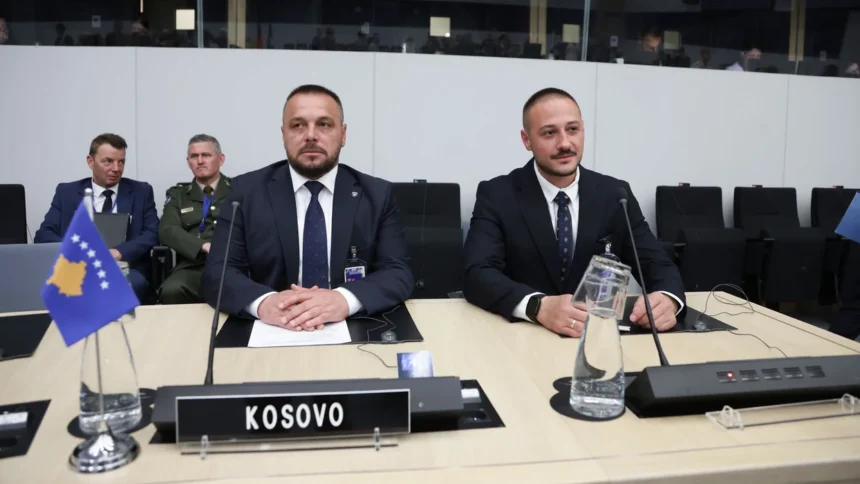
Kosovo’s Acting Minister of Defense, Ejup Maqedonci, officially reaffirmed the young republic’s unwavering alignment with Western allies during the 35th meeting of the Ukraine Defense Contact Group (UDCG). The high-level security summit, held on June 18, 2026, convened at NATO Headquarters in Brussels to address critical battlefield developments and coordinate urgent international security measures.
The session brought together roughly 50 defense ministers and military leaders from NATO member states and global partner countries, all uniting to reinforce strategic commitments toward safeguarding Ukraine’s sovereignty and territorial integrity against ongoing Russian aggression.
1. Kosovo’s Strategic Commitment to the Alliance
Despite facing complex diplomatic hurdles on its own path toward Euro-Atlantic integration, Pristina utilized the international platform to demonstrate that it operates as a de facto ally within the Western security architecture.
Pillars of Kosovo's Defense Position in Brussels

 [ ALLIED ALIGNMENT ]    ──► STRATEGIC PARTNERSHIP
 • Pristina explicitly tied its national security framework to decisions
   orchestrated by NATO and the broader G7 coalition.

 [ UKRAINE SUPPORT ]     ──► MATERIAL & POLITICAL BACKING
 • Reconfirmed active participation in humanitarian assistance, demining
   initiatives, and military training exercises tailored for Ukrainian forces.

 [ REGIONAL STABILITY ]  ──► BALKAN SECURITY MATRIX
 • Positioned Kosovo as a reliable bulwark against Russian hybrid warfare
   and geopolitical meddling in the Western Balkans.
“The Republic of Kosovo remains deeply committed to standing shoulder-to-shoulder with its partners and allies in absolute support of global peace and security.”
— Ministry of Defense Official Statement
2. Leadership of the 35th Contact Group Summit
The high-stakes ministerial session was jointly spearheaded by a powerful triumvirate of European and transatlantic defense leaders, focusing heavily on long-term industrial production and immediate ammunition supplies.
                      ┌────────────────────────────────────────┐
                      │        SUMMIT LEADERSHIP PANEL         │
                      └───────────────────┬────────────────────┘
                                          │
         ┌────────────────────────────────┼────────────────────────────┐
         ▼                                ▼                            ▼
 [ BORIS PISTORIUS ]              [ MARK RUTTE ]               [ DAN JARVIS ]
German Minister of Defense     NATO Secretary General      UK Secretary of State for Defense
3. Side-Line Diplomacy: Expanding Defense Bilaterals
On the margins of the main plenary session, Minister Maqedonci engaged in targeted diplomatic outreach. He held a series of private meetings with NATO officials and defense ministers from partner nations, aiming to bolster bilateral cooperation, advance the multi-year transition plan of the Kosovo Security Force (KSF), and address current security vulnerabilities plaguing Southeastern Europe.
| Diplomatic Track | Operational Focus Areas | Strategic Objectives |
| NATO Institutional Talks | Institutional integration and joint exercises | Accelerating Kosovo’s path toward the Partnership for Peace (PfP) program. |
| Bilateral Defense Meetings | Intelligence sharing and military procurement | Upgrading KSF defensive capabilities with modern, NATO-standard equipment. |
| Regional Security Review | Hybrid threats and border surveillance | Countering external disinformation campaigns targeting the Western Balkans. |
By maintaining a distinct, active presence at the UDCG meetings in Brussels, Kosovo continues to signal that its defense apparatus is fully capable of contributing to, rather than just consuming, international security infrastructure.