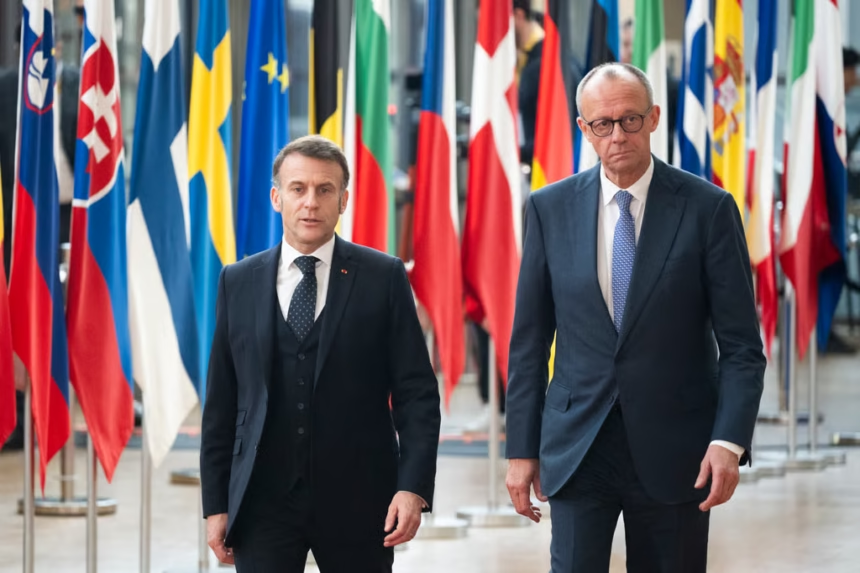
A high-stakes, closed-door European Council summit in Brussels has exposed a deep structural rift over how, when, and who should handle potential peace negotiations with Vladimir Putin.
French President Emmanuel Macron and German Chancellor Friedrich Merz led a fierce late-night revolt against European Council President António Costa, lambasting him for initiating unauthorized diplomatic outreach to Moscow. The confrontation marks the most severe institutional clash within the bloc since the departure of longtime contrarian Viktor Orbán, shattering the EU’s fragile consensus on Ukraine strategy.
1. The Inciting Incident: The Secret Moscow Phone Calls
The two-hour shouting match—held without aides or mobile phones due to security sensitivities—was triggered by revelations that Costa’s Chief of Staff, Pedro Lourtie, had secretly contacted officials in Moscow twice over the preceding weeks.
The Anatomy of a Diplomatic Fracture

 [ THE LEAK ]             ──► BREAK OF TRUST
 • Berlin, Paris, and the majority of EU capitals only discovered the Kremlin
   outreach after the leaks appeared in the media on Wednesday, sparking fury.

 [ COSTA'S DEFENSE ]       ──► THE ZELENSKYY MANDATE
 • Costa's team defended the calls as "brief and non-substantive," claiming they
   were initiated at the direct request of Ukrainian President Volodymyr Zelenskyy
   to establish an EU-controlled channel.

 [ THE RAPID REJECTION ]   ──► "NO MEDIATION"
 • Germany and France flatly rejected the explanation, asserting that Costa
   acted "highly unprofessionally" by concealing the communications from the member states.
“The European Union cannot assume the role of mediator in these negotiations. Suggestions that alternative channels or backdoor diplomatic tracks are needed are misguided… History offers a clear warning about attempts to pursue alternative negotiating frameworks with dictators.”
— Kristen Michal, Prime Minister of Estonia
2. Mapping the Faultlines: E3 vs. E5 vs. The EU Institutions
The confrontation exposed a fragmented European leadership core. Rather than a unified European voice, three competing diplomatic factions have emerged to claim ownership over Europe’s endgame strategy in Ukraine.
                  ┌────────────────────────────────────────┐
                  │    COMPETING CAMPS FOR RUSSIA TALKS    │
                  └───────────────────┬────────────────────┘
                                      │
         ┌────────────────────────────┼────────────────────────────┐
         ▼                            ▼                            ▼
   [ THE E3 CARTEL ]         [ THE INSTITUTIONALISTS ]       [ THE EXCLUDED E5 ]
 France, Germany, and the    Belgian PM Bart De Wever and    Poland and Italy are furious
 U.K. insist they must lead  a "huge number" of states back  at being frozen out of early
 any direct future Kremlin   Costa, viewing the Council as   E3-Kyiv strategy sessions.
 talks, not EU bureaucrats.  the legitimate EU negotiator.   They want a seats-at-the-table.
3. The Geopolitical Catalyst: The Trump Effect
The sudden urgency to establish a negotiating framework is driven directly by shifts across the Atlantic. U.S. President Donald Trump’s recent provisional peace deal with Iran and his clear signals at the G7 summit in France that his administration is turning its full attention back to wrapping up the war in Ukraine have panicked European capitals.
Fearful of being sidelined in a Washington-dictated peace settlement, European leaders are racing to define their leverage.
| Diplomatic Faction | Core Position on Russia Talks | Key Proponents / Alignment |
| The Big Powers (E3) | The time is not right to talk to Putin. When it is, France, Germany, and the U.K. must dictate the terms—not Brussels. | Emmanuel Macron, Friedrich Merz |
| The European Council | Believes the EU must establish its own diplomatic conduit immediately to defend European economic and security interests. | António Costa, Pedro Lourtie, backed by Belgium |
| The Baltic/Nordic Hawks | Utterly opposed to any back-channel diplomacy. View any unauthorized outreach to Putin as an existential security threat. | Estonia, Denmark, the Netherlands |
What Happens Next?
In a bid to wrestle control of the diplomatic dossier away from the Brussels bureaucracy, Friedrich Merz will host Emmanuel Macron and the Prime Ministers of the U.K., Poland, and Italy in Berlin next Wednesday.
This powerful mini-summit is intended to bypass the wider European Council, freeze out Costa, and force a unified, heavyweight European directorate capable of coordinating directly with Washington and Kyiv before Trump enforces a unilateral peace framework.