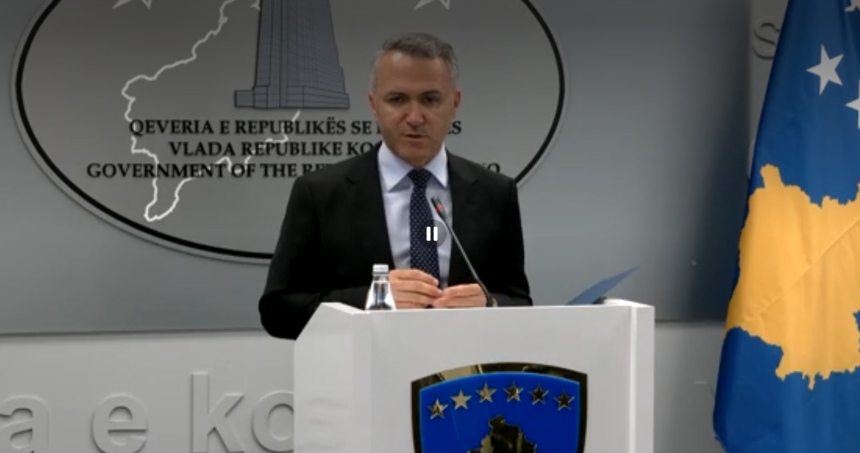
Following Ireland’s official assumption of the Presidency of the Council of the European Union on Wednesday, July 1, 2026, Kosovo’s Chief Negotiator for EU Integration, Jeton Zulfaj, voiced strong optimism that Prishtina’s long-stalled application for candidate status can finally be pushed onto the formal European agenda.
Ireland takes over the rotating six-month presidency from Cyprus, one of the five EU member states that staunchly refuses to recognize Kosovo’s independent statehood, a geopolitical reality that effectively blocked any diplomatic progress during the first half of the year.
A Four-Year Strategic Stalemate
Kosovo formally submitted its application for EU membership back on December 15, 2022. Four years later, it remains the only country in the Western Balkans that has not yet been granted official candidate country status.
“Securing candidate status and opening accession negotiations remain our primary objectives,” Zulfaj stated. “We are working intensively alongside the Irish Presidency and the European Commission to ensure Kosovo’s status enters the EU agenda. However, this is not our decision to make; it is a collective decision that the European Union must deliver.”
Zulfaj firmly maintained that Kosovo has already satisfied all technical and merit-based criteria necessary to move forward, both for receiving candidate status and for greenlighting the opening of chapters.
The Argument of Democratic Dominance
According to internal government assessments, Prishtina stands in a significantly stronger legislative and institutional position than neighboring Balkan states did at the time they received their respective candidate nods.
- Democratic Benchmarks: Zulfaj emphasized that Kosovo is structurally verified as the most advanced democracy in the region, ranking exceptionally high on independent international metrics evaluating the rule of law and internal economic development.
- Harmonization Progress: The Chief Negotiator noted that Kosovo has demonstrated continuous, documented progress in implementing sweeping domestic reforms aligned with the 33 accession chapters.
The Lengthy Road and the Five-State Hurdle
Historically, navigating the path toward full EU integration is a decade-long endeavor. For the member states that joined the bloc during the 2004, 2007, and 2013 expansions, the timeline spanning from initial application to final treaty ratification lasted anywhere from 8 to 14 years.
To successfully join, any aspiring nation must satisfy the strict “Copenhagen Criteria” (guaranteeing stable democratic governance, a robust rule of law, and a functioning market economy), alongside the region-specific requirements of the Stabilization and Association Process (SAP). For context, Croatia—the last nation to successfully enter the EU in 2013—faced a rigorous 12-year bureaucratic journey following its application.
Kosovo’s bid, however, faces a unique, unprecedented legal obstacle:
The Non-Recognizers: This marks the first time in EU history that a sovereign territory has applied for membership without being formally recognized by the entirety of the bloc. Kosovo’s path requires navigating an absolute consensus layout, which remains heavily obstructed by the five EU non-recognizers: Spain, Romania, Greece, Slovakia, and Cyprus.
While Kosovo successfully signed its landmark Stabilization and Association Agreement (SAA) in Strasbourg back on October 17, 2015, the political transition from an applicant to an official candidate under the Irish Presidency will test whether Prishtina can break through the diplomatic blockade of the non-recognizing faction.