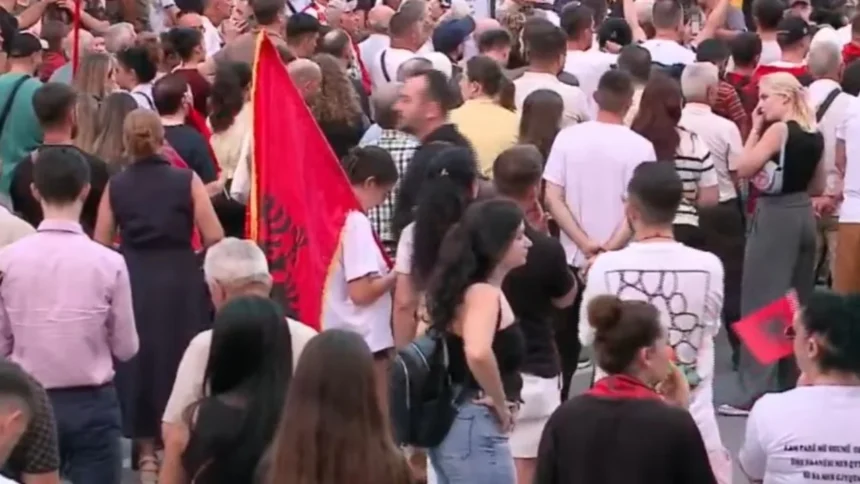
The ongoing civic wave of demonstrations in the Albanian capital reached its 32nd consecutive day on Wednesday, July 1, 2026, with organizers and participating citizens strictly maintaining their core institutional demands despite noting a structural decline in total street numbers over recent days.
Following the established route of the month-long mobilization, demonstrators originally assembled at Skanderbeg Square late in the evening before initiating their routine march down the main boulevard toward the Prime Minister’s Office (Kryeministria), where civic activists addressed the crowd from the temporary podium.
“A Plague on Both Your Houses”: Structural Demands
The protest continues to operate outside traditional, binary party structures, a position heavily reflected in the crowd’s signature core chants echoing down the boulevard:
“Revolution! Rama to prison, Berisha to prison!” (“Revolucion! Rama n’burg, Berisha n’burg”).
Speakers reiterated that the primary, non-negotiable prerequisite to halting the daily demonstrations remains the immediate and irrevocable resignation of Prime Minister Edi Rama and his entire executive cabinet. Activists explicitly clarified from the stage that their 5-point ultimatum was directly formulated by regular citizens in the square rather than political brokers or party statutes.
Fallout Over Parliament Clashes and Police Overreach
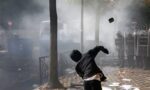
The focus of Wednesday’s speeches heavily centered on the highly volatile escalations that transpired just 24 hours prior during a targeted march outside the Parliament of Albania (Kuvendi), which was holding a plenary session.
- Allegations of Political Weaponization: Addressing the crowd from the Kryeministria steps, several civic representatives claimed that State Police units grossly exceeded their legal competencies during Tuesday’s parliamentary standoff. Speakers accused law enforcement leadership of allowing rank-and-file officers to be weaponized by establishment political factions to pull peaceful demonstrators away by force.
- Violent Friction and Direct Warnings: The sharp critique follows a highly tense 31st day of mobilization, during which protest organizers openly warned that while the movement has remained strictly non-violent for over a month, they would “no longer take responsibility for the spontaneous reactions of the public” if state authorities continue to deploy aggressive containment tactics.
The political atmosphere remains split. While Prime Minister Edi Rama countered the movement online by sharing aerial footage framing the city center as a peaceful “Tirana of equal liberties” where family life and protests coexist side-by-side, demonstrators vowed to remain anchored to the steps of the executive building until their systemic governance complaints are formally met.