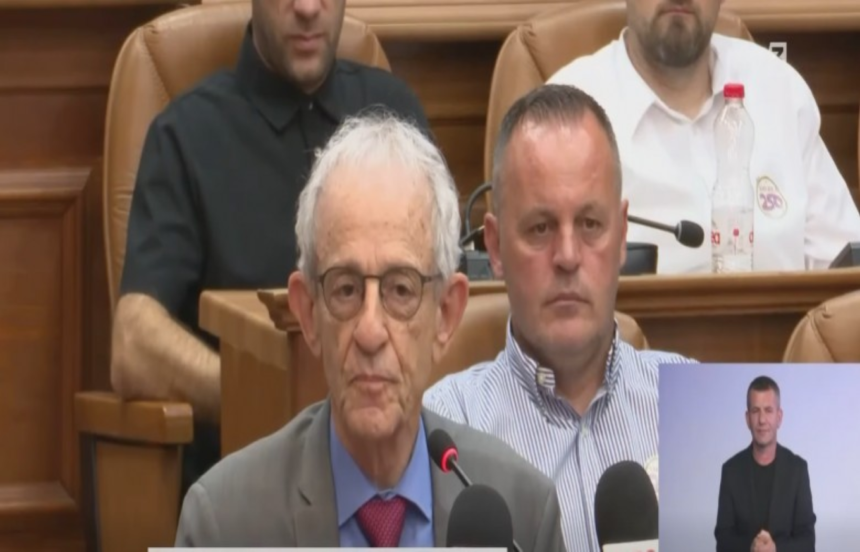
Marking the milestone 250th anniversary of United States Independence, the Municipal Assembly Hall in Prizren hosted a high-level international forum titled “American Inspiration for Kosovo on its Journey Toward Democracy and Freedom.”
The event featured an official delegation of prominent policy experts from Washington D.C., including Johns Hopkins University professor Daniel Serwer, Western Balkans analyst Edward Joseph, Albanian-American civic leader Besa Pinchotti, and defense strategist Major Mario Marquez. Local political leaders, including Prizren Mayor Shaqir Totaj, joined the international panel to discuss regional security architecture and the diplomatic realities facing the young republic.
The Collective Security Objective: NATO as the Endpoint
While celebrating the deep historic ties between the U.S. and Kosovo in times of both war and peace, the core focus of the panel rapidly shifted to the strategic barriers preventing Kosovo from fully integrating into Western institutional frameworks.
“Kosovo’s absolute future lies within NATO,” argued Professor Edward Joseph. “For Kosovo, the four alliance members that still refuse to recognize its independence represent a clear institutional obstacle. Yet, overcoming this is the exact mechanism that will ultimately unlock Kosovo’s path toward both the European Union and full, indisputable international subjectivity.”
Joseph emphasized that security guarantees must transcend temporary peacekeeping missions, pointing toward permanent membership in the Atlantic alliance as the single long-term solution to Balkan stability.
The Domestic Reality and the Congressional Agenda
Offering a more critical, pragmatic assessment of the current geopolitical climate, Professor Daniel Serwer warned that Kosovo cannot afford to become complacent, pointing to shifting dynamics within Washington itself.
- Erosion of Democratic Defense: Serwer delivered a candid critique regarding internal conditions in the U.S., noting, “We are currently in a global situation where the United States is struggling to protect democracy within its own borders, meaning it cannot always be expected to forcefully shield it in the international arena. This reality presents a massive, immediate challenge for Kosovo.”
- The Legislative Hurdle in Washington: Serwer specifically pointed to recent statements made on Capitol Hill by U.S. policymakers regarding current enlargement priorities. “Secretary Marco Rubio stated quite clearly in Congress that Kosovo’s membership in NATO is currently not on the active agenda,” Serwer revealed. “Therefore, the burden falls on Pristina. You must strategically work and lobby to ensure that it actively becomes part of that agenda.”
Self-Determination and Shifting Timeframes
Despite the challenging diplomatic forecast, Major Mario Marquez offered an encouraging perspective focused on internal state-building, asserting that “regardless of the complex international hurdles that may slow this formal process down, the people of Kosovo hold everything necessary in their own hands to build a better future.”
The Prizren forum is part of a wider, week-long series of cultural and political events being held across Kosovo to honor America’s semi-quincentennial, highlighting a partnership that local officials stress remains central to Kosovo’s national security strategy as regional tensions persist.