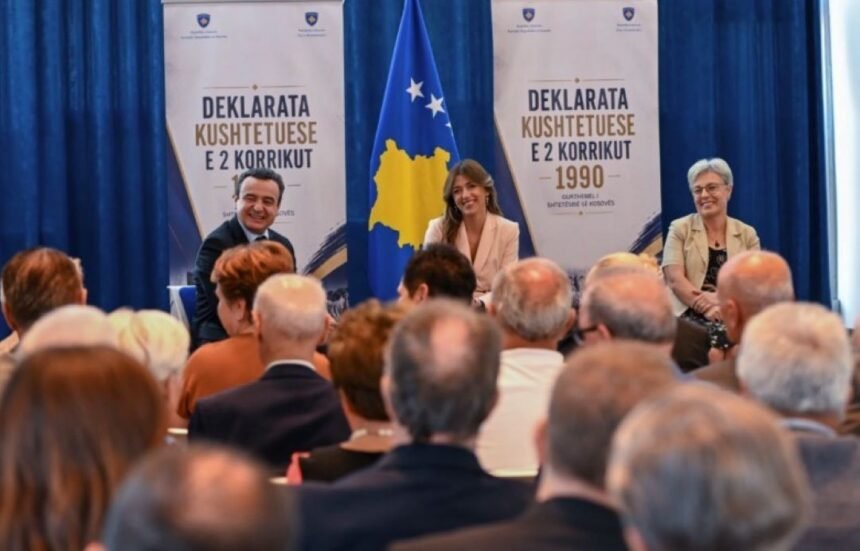
Kosovo’s top institutional leaders gather to commemorate the 36th anniversary of the historic July 2, 1990 Constitutional Declaration, hailing it as the foundational legal and political act that set the nation on its definitive path toward sovereignty and independence.
The anniversary honors the courageous actions of 111 delegates of the then-Assembly of Kosovo who, after being locked out of the official parliament building by Belgrade’s repressive forces, gathered on the building’s steps in Pristina to declare Kosovo an equal entity within the Yugoslav federation, directly defying Slobodan Milošević’s revocation of its autonomy.
A Defiant Voice Against Subjugation
Acting President Albulena Haxhiu highlighted that while the political space for ethnic Albanians in 1990 was systematically constricted by the Serbian regime, the delegates refused to submit to autocratic silencing.
“Serbia aimed for more than just governing Kosovo; it sought to leave it without a political voice,” Haxhiu stated. “Kosovo at that time had very little space, but it had people who knew how to utilize that minimal space with wisdom and courage. The delegates proved that Kosovo’s politics must speak the language of justice and rights, not the language of subjugation.”
Haxhiu underscored that the July 2nd declaration triggered a vital institutional chain reaction, leading directly to the Kaçanik Constitution on September 7th, the subsequent independence referendum, and the alternative “underground” network of home-schools and universities that kept civil life alive throughout the 1990s.
The Legal and Political Birth of the Republic
Acting Prime Minister Albin Kurti characterized the 1990 declaration as the literal birth certificate of the Republic of Kosovo, establishing the enduring framework for institutional and peaceful resistance.
- A Monument of Will: “The Constitutional Declaration was an expression of freedom, but also of equality,” Kurti remarked, noting that it was hammered out just 18 months after Belgrade aggressively stripped away Kosovo’s constitutional autonomy.
- The Kaçanik Connection: Kurti emphasized how the declaration seamlessly dovetailed with the clandestine assembly held two months later in Kaçanik, framing them as an indelible, complementary legal monument that circulated massively and bravely among the populace.
A Shared Historical Legacy
Ilaz Ramajli, who served as the Chairman of the Assembly delegates who boldly cast their votes outside the locked parliament in 1990, expressed deep pride when viewing the contemporary landscape of the country.
He stressed that the honor of the day belongs fundamentally to the citizens of Kosovo who, during an extraordinary era of danger, chose to believe in self-determination and human dignity. “When I see Kosovo today as a free, independent, and democratic state, I am even more convinced that the July 2nd Declaration was not merely a legal document,” Ramajli concluded. “It was the political spark of a historical process that—despite immense sacrifice—was ultimately crowned with our statehood.”