A comprehensive new public opinion survey has exposed deep domestic fractures in Serbia, revealing that a clear majority of citizens view the national police force as highly politicized, structurally corrupt, and more invested in shielding organized crime and politicians than protecting everyday citizens.
The extensive study, conducted by the Belgrade Centre for Security Policy (BCBP) in collaboration with the Smart Plus research agency, utilized a randomized, nationally representative sample. The findings deliver a staggering statistical rebuke of the state’s law enforcement apparatus and the broader political climate under the ruling administration.
The “Sound Cannon” Timeline and Public Skepticism
The survey directly addressed the highly controversial public gathering on March 15, 2025, which remains a central point of friction between opposition lawmakers and the Higher Public Prosecutor’s Office (VJT).
When asked whether they believed the state deployed long-range acoustic weaponry—the so-called “sound cannon”—against civilian demonstrators, the public responded with notable skepticism toward official government denials:
- 47.2% of respondents stated “Yes”, believing the sonic weapon was used.
- 36.8% answered “No”.
- 16.0% refused to answer or stated they did not know.
The BCBP noted that because the polling was conducted in May, before the VJT launched its active investigation into “simulated events” regarding the cannon, current public fear and judicial intimidation might skew subsequent responses. However, authors emphasize that institutional pressure has not rewritten the public’s baseline perception.
Shocking Lack of Trust in Law Enforcement
The data paints a grim picture of how Serbian society views the Ministry of Internal Affairs (MUP). Rather than viewing the police as a shield for public safety, a plurality of the country believes the institution serves the ruling elite and the criminal underworld:
Who Do Serbian Citizens Believe the Police Protect Most?
├── 45.6% ──> Criminals and Underworld Outlaws
├── 44.6% ──> Politicians Who Misuse State Resources
├── 39.4% ──> Financially Powerful Tycoons
└── 41.1% ──> Law-Abiding Citizens and Private Property
(Note: Respondents could select multiple options).
Furthermore, the public draws a sharp distinction within the police hierarchy. 39.4% of citizens view top police executives as deeply corrupt, compared to 20.8% who say the same of ordinary beat officers. Respondents cited a total lack of institutional sanctions, a culture of conformity (“everyone does it”), and explicit encouragement from supervisors as the primary drivers of police corruption. The study also revealed widespread consensus that recruitment and promotions are overwhelmingly governed by political connections and nepotism rather than meritocratic public contests.
Rejection of Brutality, Masks, and “Ćacilend”
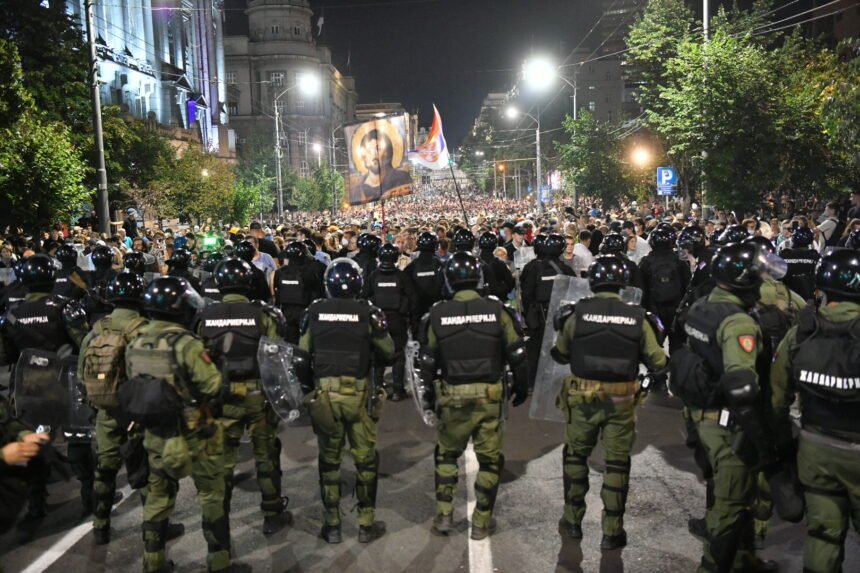
The study recorded an overwhelming public rejection of the tactical methods utilized by security forces since the outbreak of the massive student protest movement.
- Opposing Covert Policing: Over 70% of those polled strongly disapprove of tactical officers wearing balaclavas (“fantomke”) or intentionally concealing their identification badges on uniforms and gear during public rallies.
- Banning Excessive Force: Approximately 80% of citizens oppose the use of sonic weapons and rubber bullets, stating they should never be deployed, even against violent demonstrators.
- Dismantling “Ćacilend”: The polarization extends to symbols of political unrest in the capital. Three-quarters (75%) of all Serbian citizens demand the immediate removal of “Ćacilend”—the highly disruptive protest tent city currently occupying the space between the Presidency and the National Assembly.
Security as a Political Category: The Generational Divide
The BCBP research underlines that personal safety in modern Serbia has become an entirely partisan issue. Citizens who report feeling secure are almost exclusively staunch supporters of the ruling party. Conversely, regime critics and opposition voters report feeling chronically unsafe not just at political rallies, but across everyday facets of civil life—including public institutions, voting booths, and their private workplaces.
This pervasive anxiety tracks directly along demographic and generational lines:
The Youth vs. The Elderly: The oldest demographic cohort (65 and older) emerged as the segment that feels the absolute safest and most satisfied with state performance. Conversely, young adults aged 18 to 24 feel the least safe and express the sharpest dissatisfaction with state institutions.
As the current security apparatus and judiciary focus their weight on suppressing student movements, the study concludes that Serbia’s youth are bearing the brunt of systemic state violence, leaving them with zero institutional avenues for protection.