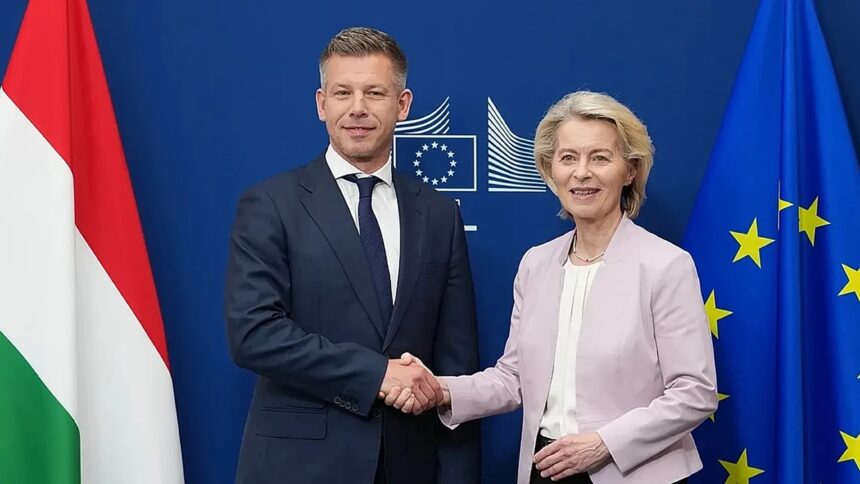
Hungary appears to be on track to meet the remaining conditions required to unlock €10 billion in EU recovery funding before the end-of-August deadline, according to Euronews, citing discussions with European Commission and Hungarian officials.
Meeting all the outstanding requirements would allow Budapest to access billions in previously frozen EU funds and represent a significant political achievement for Prime Minister Péter Magyar, who campaigned on a promise to restore Hungary’s access to EU money after ending Viktor Orbán’s 16-year rule.
In May, Hungary and European Commission President Ursula von der Leyen agreed on a framework for releasing €16.4 billion in previously frozen EU funds. Of that amount, €10 billion comes from the EU’s Recovery and Resilience Facility (RRF), which is approaching its expiration deadline, while another €6.4 billion is allocated through cohesion funds.
A European Commission source told Euronews that the process is progressing well and that Hungary has a realistic chance of meeting all the conditions and accessing the recovery funds by autumn.
The Hungarian government has similarly indicated that significant progress has been made, saying that approximately two-thirds of its commitments have already been fulfilled and that the remaining measures are in their final stages.
Hungary must complete 27 so-called “super milestones” set by the European Commission. Twenty-one concern corruption and transparency, four relate to judicial independence and two involve auditing and oversight of EU funds.
Among the measures already adopted are a comprehensive anti-corruption package, stricter asset-declaration rules for politicians, greater transparency in public procurement and changes affecting public-interest asset-management foundations.
Hungary has also established a new anti-corruption body tasked with recovering state assets allegedly connected to corruption during the Orbán era. The Magyar government has additionally initiated the process for Hungary to join the European Public Prosecutor’s Office.
The government has also revised its national recovery plan to facilitate access to the funds, including investments in the energy grid, railways and rental housing.
If Budapest completes all remaining milestones by the end of August, the European Commission is expected to assess the reforms in September. A payment request would then follow, potentially allowing the funds to be released later this year.
The process therefore represents more than a financial issue for Hungary: access to billions of euros is becoming a concrete test of whether the country’s new government can deliver the institutional reforms demanded by Brussels.