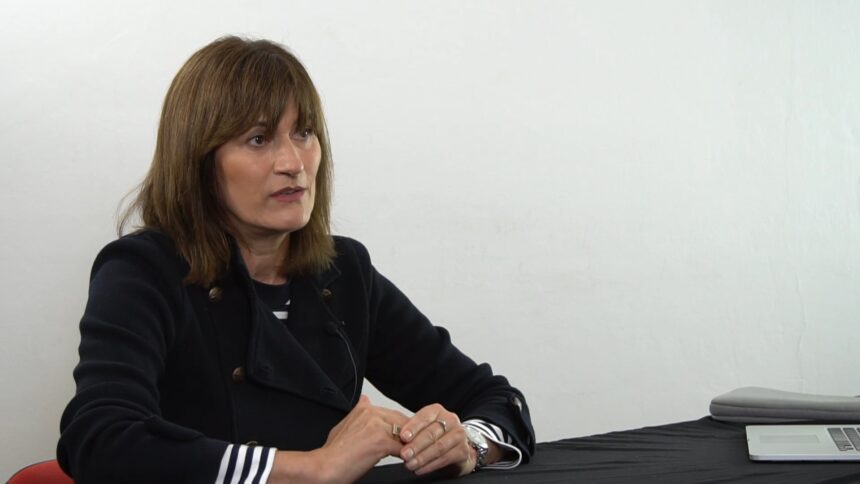
A final verdict in the trial of former Kosovo Liberation Army leaders Hashim Thaçi, Kadri Veseli, Rexhep Selimi and Jakup Krasniqi may not bring an immediate end to the legal proceedings, according to Nevenka Tromp, a former official of the International Criminal Tribunal for the former Yugoslavia.
Speaking to Radio Kosovo one day before the Kosovo Specialist Chambers in The Hague are due to issue their judgment, Tromp said there was insufficient information to reliably predict whether any of the four defendants would be convicted.
She said the only available point of comparison was the previous KSC cases involving Salih Mustafa and Pjetër Shala, both of whom were convicted and sentenced to prison terms.
“Based on these two judgments, there is a possibility that at least one of the four defendants could be sentenced to imprisonment,” Tromp said, while stressing that this did not provide a reliable basis for predicting which defendants might be convicted.
Individual criminal responsibility remains central
Tromp said the large volume of evidence presented during the trial makes it extremely difficult for anyone outside the court to anticipate the judges’ conclusions.
She identified two broad factors that could shape the judgment: the legal assessment of the evidence and the wider political context surrounding the establishment and operation of the Specialist Chambers.
She also emphasized the distinction between political or hierarchical responsibility and individual criminal responsibility.
According to Tromp, previous KSC cases involved defendants who occupied lower or middle-level command positions, where the connection between alleged crimes and an individual commander can be more direct.
For senior political and military leaders, however, she said the prosecution must establish a much more complex connection between crimes allegedly committed on the ground and the alleged criminal intent or common purpose of those at the top of the hierarchy.
Tromp pointed to the ICTY cases of former KLA commanders Fatmir Limaj and Ramush Haradinaj, who were acquitted, arguing that prosecutors had failed to establish the necessary connection between crimes allegedly committed on the ground and the criminal intent of the leadership.
She said the current case could have a significantly greater impact if the Specialist Chambers were to establish that a common criminal enterprise existed at the highest levels of the KLA.
Such a finding, she argued, could generate strong political resistance in Kosovo because of its potential implications for how the 1998–1999 war and the country’s independence are understood.
Three possible scenarios
Tromp outlined three broad scenarios for Wednesday’s judgment.
The first would be an acquittal of all four defendants. The second would be convictions for all four. The third would involve a mixed verdict, with some defendants convicted and others acquitted.
She said a mixed verdict was, in her assessment, the most plausible scenario, although she stressed that the outcome could not be predicted with confidence.
Tromp argued that each scenario would have different political consequences in Kosovo and Serbia.
An acquittal of all four, she said, could be interpreted as evidence that the legal assessment of the evidence had prevailed. Convictions, meanwhile, could reinforce Serbia’s longstanding political narrative about alleged crimes by former KLA leaders.
She also predicted that Serbian President Aleksandar Vučić would seek to use the verdict politically ahead of Serbia’s October 25 elections, regardless of whether the defendants are convicted or acquitted.
In Kosovo, Tromp warned that a verdict involving convictions could deepen existing divisions between supporters and critics of the KLA.
She urged Kosovo’s political and social forces to remain united and warned that further fragmentation around the Specialist Chambers would ultimately benefit Serbia.
Debate over Kosovo’s wartime narrative
Tromp also argued that Kosovo had not done enough to establish and institutionalize its own historical narrative about the war and the suffering of its population.
She said responsibility for preserving that historical record should not simply be attributed to the “West,” but should also rest with Kosovo’s political, social, academic and cultural institutions.
According to Tromp, Serbia has pursued a long-term effort to reshape the narrative surrounding the wars of the 1990s through political, diplomatic, cultural and academic channels.
She argued that Kosovo should have done more to preserve its own historical record through education, museums, monuments and academic research.
Tromp described the establishment of the Specialist Chambers in 2015 as a warning that Kosovo needed to take greater responsibility for documenting and communicating its understanding of the conflict.
She also said Kosovo had initially placed significant trust in international criminal justice because of its desire to remain aligned with the broader liberal international order and its Western allies.
Appeal could prolong the case for years
Tromp said an important issue often overlooked in public discussion is what happens after the first-instance judgment.
She criticized what she described as efforts to reassure Kosovo’s public that any convictions should not immediately trigger major protests because an appeal would follow.
According to Tromp, an appeal would not simply reopen the entire trial. Rather, the appeals process would examine whether the first-instance judgment involved errors in the application of law or other grounds permitted under the court’s rules.
She warned that the appeal process could take years and said there was no guarantee that an appeal would overturn the first-instance judgment.
“It is absolutely possible that the appeal could confirm everything that was decided at the first instance,” Tromp said.
She therefore cautioned against treating Wednesday’s judgment as necessarily the final chapter of the proceedings.
The trial has already lasted several years, and any convictions could be followed by another lengthy legal process before a final judgment is reached.
For Kosovo, Tromp said, the immediate challenge would be to manage the political and social consequences of the verdict while avoiding further polarization.
“Whatever happens in The Hague, my message to Kosovo’s society is to remain united,” she said, warning that deeper political and social fragmentation over the Specialist Chambers could ultimately serve Serbia’s interests.
The Specialist Chambers are scheduled to announce their judgment in the case against Thaçi, Veseli, Selimi and Krasniqi on September 16.